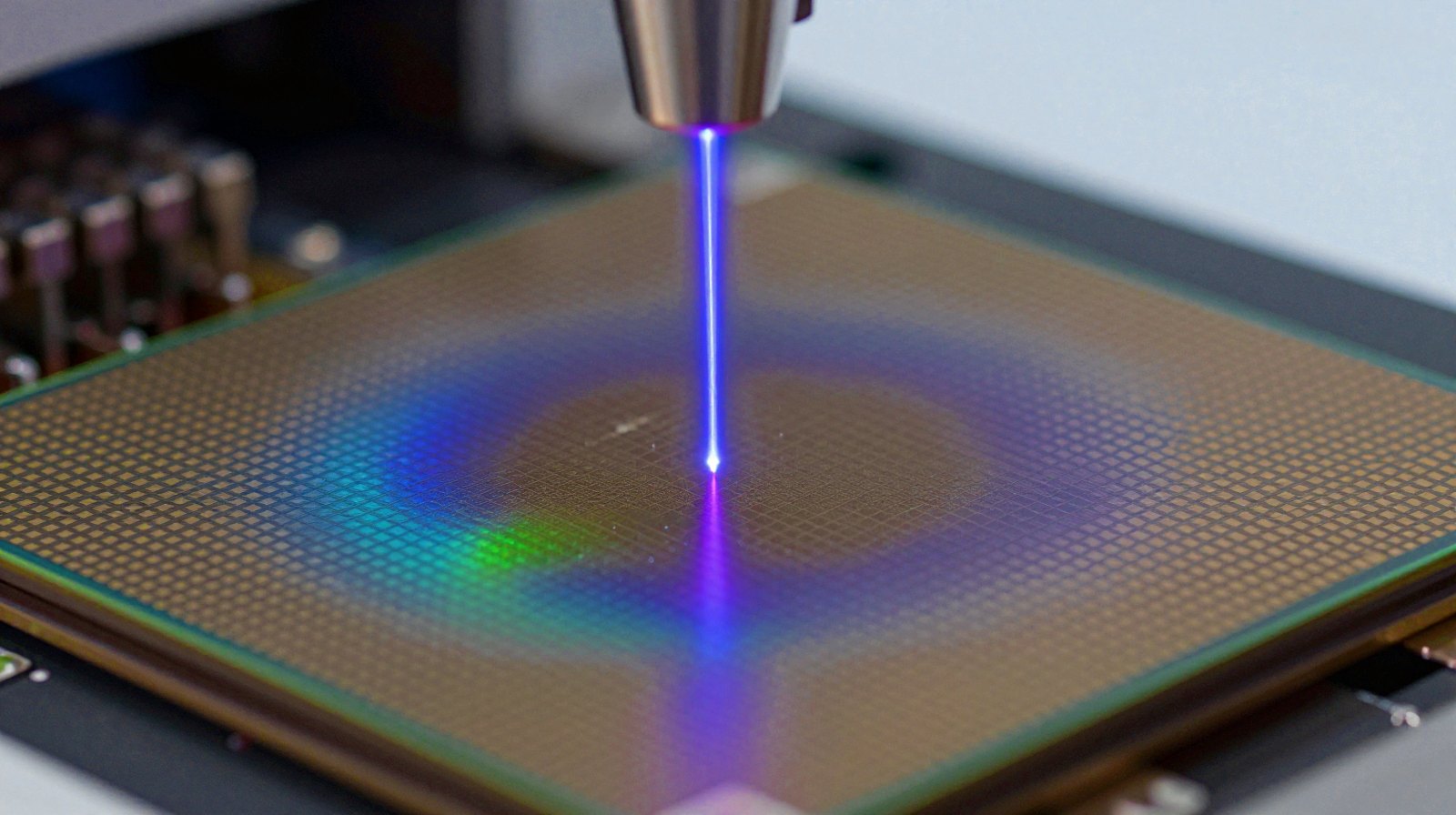
Japan used to make many of the world’s most advanced chips, then spent decades watching Taiwan, South Korea and the US race ahead. Now it is trying to jump straight back to the front. A young company called Rapidus is building 2-nanometre chips, the most advanced class of processors on the market, in a brand-new factory on the northern island of Hokkaido. On 5 October it took its next big step, opening its doors to chip designers from around the world.
Why it matters: almost every leading-edge chip today, the brains of AI servers and top smartphones, is made by a tiny number of factories, mostly in Taiwan. A second source in Japan would make the world’s supply less fragile. It would also be one of the boldest comebacks in industrial history: Rapidus was founded only in 2022.
What “2 nanometres” really means
A nanometre is a millionth of a millimetre; a human hair is roughly 80,000 to 100,000 nanometres wide. But “2nm” is more of a generation name than a ruler measurement. What it promises is more transistors (the tiny on-off switches that do all the computing) packed into the same space, so chips get faster and use less energy.
To get there, Rapidus uses a newer transistor design called gate-all-around (GAA), developed with IBM. Imagine a tap that controls the flow of water: older transistors grip the “pipe” from three sides, GAA wraps the control around all four, so it leaks less and switches more precisely. The patterns are printed with EUV lithography, machines that use extreme ultraviolet light to draw features far smaller than ordinary light allows.
How far Rapidus has come
- July 2025: Rapidus announced its first 2nm GAA transistors made at its IIM-1 plant in Chitose, Hokkaido, Network World reported. Early performance was not yet where it needed to be, but improved quickly from September 2025, TrendForce wrote, citing Nikkei XTech.
- Speed: work that reportedly took about a year and a half at IBM’s research base in Albany, New York, was repeated in under two months in Chitose, according to the same report.
- Late 2026: Rapidus plans to start producing customers’ own 2nm test chips.
- 2027: production for clients is planned for the second half of Japan’s fiscal year that starts in April 2027, TNW reports.
The new step: a club of chip designers
A factory is only half of the story. Companies need help turning their ideas into designs that a brand-new process can build. So Rapidus launched Rapidus CORE, a global partnership programme. Its first group, the Design Solution Associates, has 17 members, including the US design-software leaders Cadence and Synopsys, India’s Infosys, Wipro and HCL, and Japan’s Toppan and Dai Nippon Printing. Rapidus describes them as “a bridge between customers and Rapidus”, and plans to add partners for design tools and ready-made circuit blocks next.
There is a reason for the hurry: Rapidus has not yet named a single production customer, TNW notes. It has about $15 billion in state backing, and Prime Minister Sanae Takaichi sees it as central to rebuilding Japan’s chip industry, but it still has to win orders from companies that are used to TSMC.
The big challenges
- Yield: the share of good chips on each silicon wafer decides whether a fab makes money. Running a first-ever leading-edge factory at high yield is extremely hard, analysts warn.
- Competition: TSMC, Samsung and Intel’s foundry business are all chasing the same customers, and some likely clients say they can’t move all their work away from TSMC.
- Talent: Rapidus itself points to a global shortage of advanced chip engineers, which is one reason CORE exists.
What happens next
The next milestones to watch are the first customer test chips at the end of this year and, above all, the first named customer. Rapidus is already looking further ahead too: it reportedly plans to start developing a 1.4nm process in 2026, aiming for production around 2029. If Hokkaido delivers, the next chip in your phone or in the cloud could be “made in Japan” again.
Read next
- Boiling coolant inside chips: a safer way to tame AI heat
- NTT moves data with light, not wires, inside AI data centres
- Nvidia RTX Spark: laptops that run big AI models offline
Sources
- Rapidus Unveils “Rapidus CORE”, New Global Ecosystem Framework – Rapidus Corporation, 5 October 2026
- Japan’s Rapidus teams up with 17 firms to win customers for 2nm chips – TNW, 7 October 2026
- Rapidus Accelerates 1nm Push, Reportedly Targets Six-Month Gap with TSMC – TrendForce (citing Nikkei XTech), 30 March 2026
- Japan’s semiconductor industry battles back – Network World