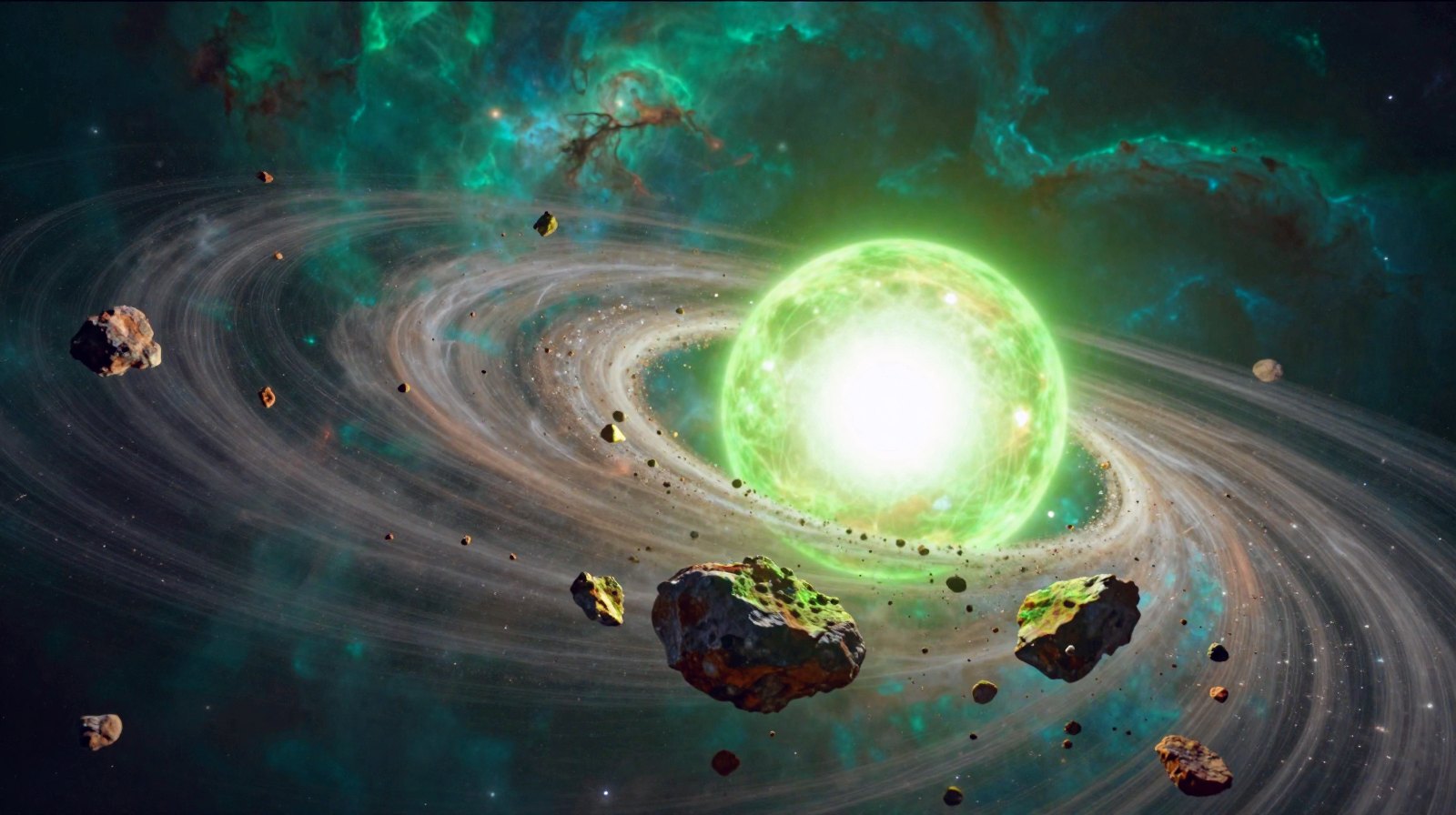
Ask anyone the colour of a star and you’ll hear red, orange, yellow, white or blue. Never green. Now astronomers at the University of Warwick have found the first star that would genuinely look green to a human eye: a small, dead star called WD J1330+6435, as reported by ScienceDaily and Popular Science.
Why it matters: it is a lovely surprise, but it is also a new tool. A star’s colour turns out to be a quick clue to what it has swallowed, including the remains of its own planets. And because our Sun will one day end up as this kind of star, it is also a glimpse of our Solar System’s far future.
A dead star with a green glow
WD J1330+6435 is a white dwarf: the hot, Earth-sized core left behind when a star like the Sun runs out of fuel and puffs away its outer layers. It is a cool one, at about 4,000 °C, and it has pulled rocky debris from its old planetary system into its atmosphere, adding calcium, lithium and sodium, according to both ScienceDaily and Popular Science.
The sodium is the trick. It soaks up the yellow, orange and red part of the star’s light, so what is left reaches us as a pale chartreuse green. Lead researcher Mark Hollands describes it as “a ghostly green glow”.
Why normal stars can’t be green
Ordinary stars shine across all colours at once. Even when a star’s light is strongest in the green, the full mix still looks white to our eyes, which is why green stars were thought impossible. To see something else, you need an atmosphere that blocks a big chunk of the rainbow.
The coolest white dwarfs can do exactly that. Their atmospheres are squeezed to a density of about 1 gram per cubic centimetre, roughly that of water, report ScienceDaily and Popular Science. Squeezed that hard, even small amounts of elements absorb light across a much wider range of colours than usual.
Pink, yellow, cyan, and possibly the reddest star yet
The team studied 151 white dwarfs within 20 parsecs (about 65 light-years) of Earth. Five had unusual colours: two yellow and three pink. That suggests roughly 1 in 30 white dwarfs shows an unexpected tint, as Phys.org and Popular Science report.
- Pink or purple: white dwarfs rich in carbon.
- Yellow: ones that have swallowed bits of destroyed asteroids and comets.
- Cyan or pale blue: cool ones with hydrogen and helium atmospheres under huge pressure.
The team also flags WD J1011+2845, about 48 light-years away, as possibly the reddest star ever recorded. Carbon dredged up from its interior pushes most of its light beyond 600 nanometres, giving a deep salmon-pink glow.
How do you measure a colour you can’t see?
Nobody has looked at these stars with the naked eye: they are far too faint. Instead, the team took each star’s spectrum (its light split into a rainbow and measured colour by colour) and ran it through a model of human colour vision, the same kind of maths that lets a camera or a TV reproduce colours you recognise. So “green” means: this is the colour you would see if you could get close enough.
And the big picture is reassuring for anyone who loves textbooks: the median colour of the other 146 stars is about 6,800 K, which the eye sees as white. As co-author Boris Gänsicke puts it, “the average white dwarf really is white.” The study, “Any colour you like: the diverse chromaticities of white dwarfs”, is published in RAS Techniques and Instruments.
What happens next
Colour is cheap to measure, so astronomers can use it to spot white dwarfs that are eating rocky material or hiding unusual chemistry, then follow them up with big telescopes. Each one is a forensic report on how planetary systems end. In about five billion years, our Sun will become a white dwarf too. Whether it ends up white, pink or even a little green may depend on what is left of the planets around it.
Read next
- Phoenix planet: a world born after its star died
- Webb spots a possible supernova just days after it exploded
- Nobel Prize in Physics 2026: a telescope made of Antarctic ice
Sources
- Astronomers discover a ghostly green star unlike any known before – ScienceDaily (University of Warwick), 19 October 2026
- Astronomers discover first green star and the reddest star ever recorded – Popular Science, 15 October 2026
- Green, pink and purple: Astronomers reveal the surprising true colors of white dwarf stars – Phys.org, 14 October 2026
- Any colour you like: the diverse chromaticities of white dwarfs – M. Hollands et al., RAS Techniques and Instruments, 2026