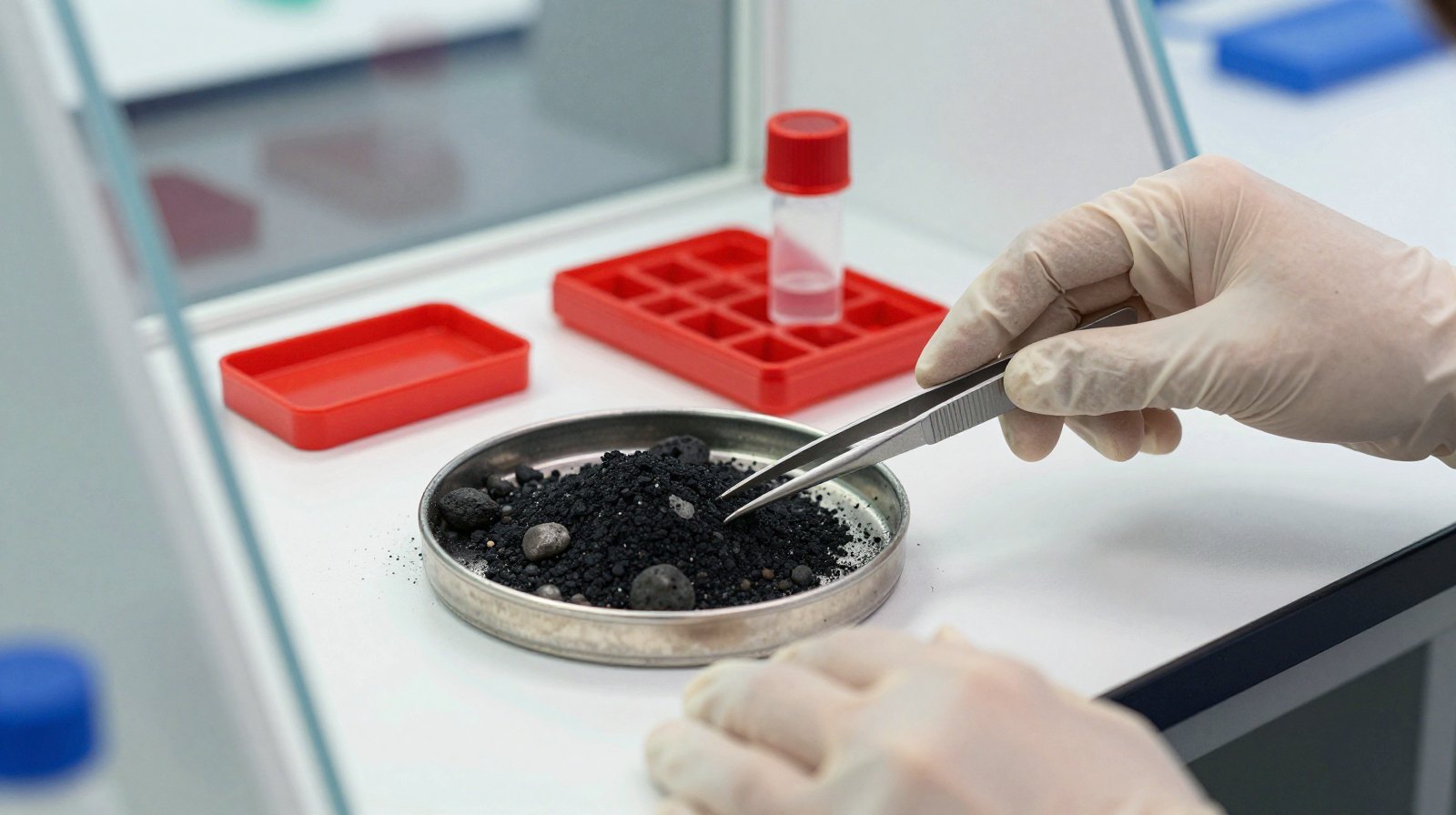
A pinch of dust from asteroid Bennu has just told scientists where it was born, and the answer is neither here nor there. A team at ETH Zurich measured chemical fingerprints in the samples NASA’s OSIRIS-REx mission brought home and found that Bennu is a “hybrid”: a mix of material from the hot inner Solar System and the icy outer one, as the researchers report in Science Advances.
Why it matters: Bennu has barely changed in about 4.5 billion years, so it is a time capsule of the dust that also built the young Earth. Knowing where that dust came from, and who stirred it, helps explain how rocky planets got their ingredients, possibly including the water in our oceans.
A spoonful of asteroid
OSIRIS-REx collected loose rock and dust from Bennu’s surface and dropped it in a capsule over the Utah desert in September 2023: about 120 grams in total, according to ETH Zurich’s announcement and The Brighter Side of News. Labs around the world each received a small share. Professor Maria Schönbächler’s isotope lab in Zurich used its portion for a very precise kind of chemistry.
The team measured isotopes of three metals: iron, titanium and chromium. Isotopes are versions of the same element with slightly different weights. Different parts of the early Solar System ended up with slightly different mixes of them, so the mix works like a postcode: it tells you which neighbourhood a rock came from.
Neither inside nor outside
The iron and titanium fingerprints turned out to be remarkably even throughout the Bennu material. Chromium varied more, which the authors put down to liquid water that later soaked through Bennu’s parent body. And the fingerprint matches two old acquaintances: asteroid Ryugu, sampled by Japan’s Hayabusa2, and the rare CI meteorites, carbon-rich space rocks that are among the most primitive ever found. All three differ clearly from other asteroids, meteorite groups and planets.
The surprise is where the fingerprint sits: halfway between the inner and outer Solar System. “Bennu is a hybrid: the material does not clearly match either the inner or the outer Solar System,” Schönbächler says in the ETH announcement.
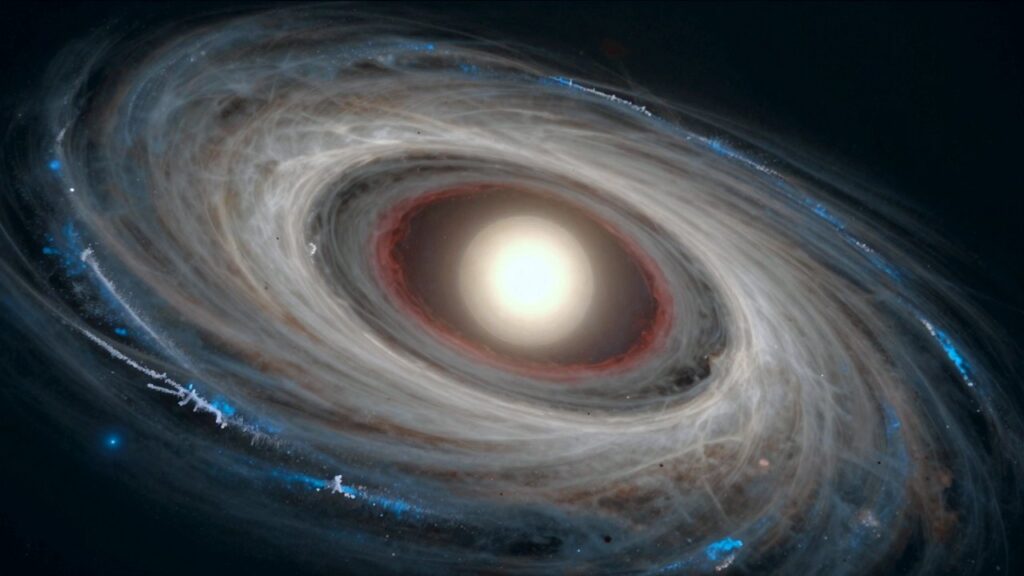
The researchers think the parent material gathered near the water-ice line (the “snow line”), the distance from the young Sun where water vapour froze into ice. There, dust from both sides mixed, and ice helped the tiny grains stick together. That places Bennu’s birthplace closer to the Sun than the regions where comets formed.
Jupiter, the cosmic sieve
So how did fine dust from both sides end up in the same place? The team points to Jupiter. As the giant planet grew, its gravity seems to have worked like a size-selective filter, or a kitchen sieve: it held back larger particles but let fine dust slip across its orbit and mix, both sources report. That would also explain why Bennu is full of fine-grained material but has few of the larger, once-molten droplets (called chondrules) found in many other meteorites.
There is a bonus. Materials like Bennu’s, Ryugu’s and the CI meteorites have an elemental make-up very close to the Sun’s, minus the most volatile elements. Since the Sun holds more than 99 % of the Solar System’s mass, these rocks are the best sample we have of the original recipe.
What we still don’t know
The study is careful about its limits. The snow line moved as the young Sun and its disc changed, models of Jupiter’s early growth are still uncertain, and nobody can yet say whether Bennu, Ryugu and the CI meteorites come from one parent body or several made of the same stuff, notes The Brighter Side of News. Bennu is not perfectly pristine either: it is a “rubble pile” that was broken apart and stuck back together.
What happens next
The obvious next step is to check other primitive asteroids for the same fingerprint. One more sample is on its way: Japan’s MMX probe launched this week to collect soil from Phobos, a moon of Mars, and bring it home in 2031, as we reported in Japan’s MMX launches to bring home soil from Mars’s moon Phobos. According to ETH Zurich, Schönbächler plans to apply for some of it.
Read next
- Japan’s MMX launches to bring home soil from Mars’s moon Phobos
- First green star found: a dead star that glows chartreuse
- Perseverance sets record for the longest drive on another world
The week's best tech stories, free
One email a week with the stories that matter, explained simply. No spam.
Sources
- Nucleosynthetic constraints on the origin of Bennu and CI-like asteroids – Science Advances (Schönbächler et al.), vol. 12, issue 39, September 2026
- NASA’s asteroid Bennu samples reveal a 4.5-billion-year-old secret – ScienceDaily (ETH Zurich), 24 October 2026
- Asteroid Bennu may have formed much closer to the Sun than scientists thought – The Brighter Side of News (Joseph Shavit), 26 September 2026
- Launch result of the Martian Moons eXploration (MMX) spacecraft – JAXA, 20 October 2026