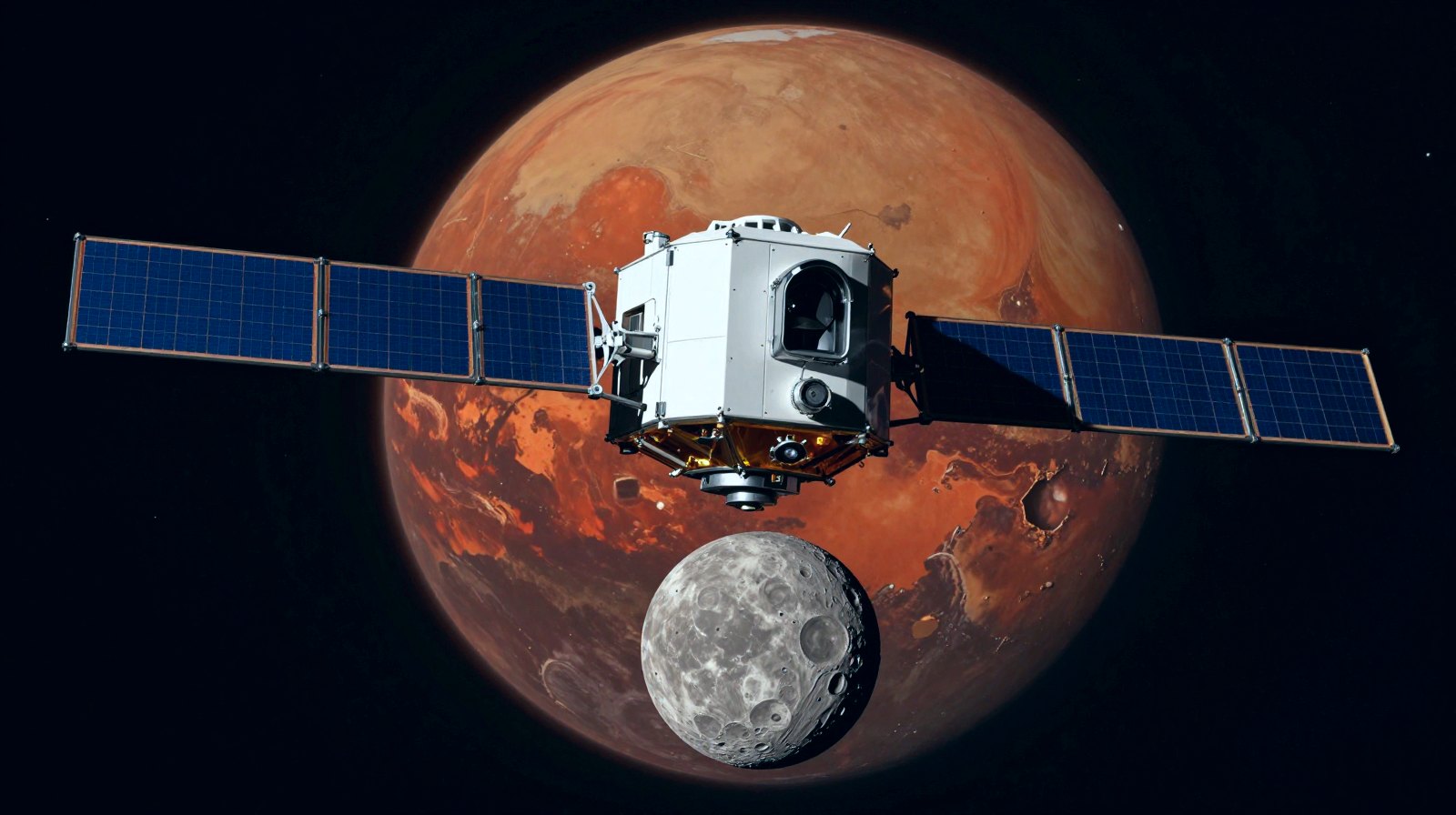
Japan has just launched a spacecraft to fetch a piece of a Martian moon. JAXA’s Martian Moons eXploration (MMX) probe lifted off on an H3 rocket from the Tanegashima Space Center at 04:41 Japan time on 20 October 2026 (21:41 in Spain the evening before), and separated from the rocket about 71 minutes later, right on plan, according to JAXA and AFP via Phys.org.
Why it matters: nobody has ever landed on Phobos, the bigger of Mars’s two little moons, let alone brought a piece of it home. If MMX succeeds, scientists will finally be able to answer a question that has nagged them for decades: where did these moons come from? And the answer reaches far beyond Mars, to how rocky planets like ours got their water and building blocks.
A five-year round trip
The plan is long but clear. MMX should reach Mars in August 2027, about a year after launch, then spend roughly three years studying Phobos from close range, report SpacePolicyOnline and the European Space Agency. It will touch down to collect at least 10 grams of surface material (about two teaspoons of soil), fly past the smaller moon Deimos, and send the samples home in a capsule that lands in Australia in 2031.
Phobos is a strange place to land. It is a lumpy rock about 27 kilometres across at its widest, and its gravity is less than a thousandth of Earth’s, according to the German space agency DLR. MMX can’t even orbit it in the normal way: it will fly in a “quasi-satellite” orbit, circling Mars while staying close to Phobos the whole time, as Astronomy explains.
A rover that weighs as much as a letter
MMX carries a passenger: Idefix, a rover about the size of a drinks crate built by the French and German space agencies, CNES and DLR. On Earth it weighs about 25 kilograms. On Phobos it will weigh roughly 15 grams, about as much as a letter in an envelope, says ESA.
Idefix will be dropped from about 40 metres up around 2029 and should work for about 100 days, scouting the ground so the mothership can pick a good spot to collect its sample, according to DLR. It will be the first wheeled vehicle ever to drive in gravity that weak, which is a real engineering puzzle: push too hard and you simply float away.
Captured asteroid or a chip off Mars?
There are two big ideas about where Phobos and Deimos came from. One says they are asteroids that wandered too close and were captured by Mars’s gravity. The other says they formed from debris blasted into orbit when something huge smashed into young Mars, much like the leading theory for our own Moon, as both ESA and AFP describe.
A few grams of real soil can settle that. Lab instruments on Earth can read the chemistry and age of the grains far more precisely than any spacecraft. Phobos’s surface is also likely sprinkled with material thrown off Mars over billions of years, so the sample may contain tiny bits of Mars itself, notes ESA.
A team effort, and a stepping stone
MMX is JAXA’s third sample-return mission, after Hayabusa (asteroid Itokawa) and Hayabusa2, which brought back 5.4 grams from asteroid Ryugu in 2020. NASA supplied two instruments: MEGANE, which maps Phobos’s chemistry from orbit using gamma rays and neutrons, and a pneumatic sampler that blasts grains into a container with gas. In return NASA gets at least 15 % of the sample, reports SpacePolicyOnline. ESA provides deep-space radio hardware and ground-station support.
JAXA also sees Phobos as a possible “natural space station” for future crewed trips to Mars, according to AFP: a place close to Mars where little fuel is needed to land and take off again.
What happens next
Now comes the quiet part: a year-long cruise, with engine burns and health checks along the way. The next big moment is arrival at Mars in August 2027, then months of mapping before anyone dares to land. Earlier attempts to visit Phobos, by Soviet and Russian probes in 1988, 1989 and 2011, never reached the surface, as Astronomy recalls. If all goes to plan, a small capsule full of Martian-moon soil will parachute into the Australian outback in 2031.
Read next
- Phoenix planet: a world born after its star died
- First green star found: a dead star that glows chartreuse
- Rapidus 2nm: Japan’s bid to build the world’s tiniest chips
Sources
- Launch result of the Martian Moons eXploration (MMX) spacecraft aboard H3 Launch Vehicle flight No.10 – JAXA, 20 October 2026
- Japan to launch world-first mission to moon of Mars – AFP via Phys.org, 19 October 2026
- JAXA’s MMX Mars mission readies for launch with two NASA instruments – SpacePolicyOnline, 15 October 2026
- MMX factsheet – European Space Agency, October 2026
- Off to the moons of Mars: MMX mission and Idefix rover ready for launch – DLR, 1 September 2026
- Japan prepares to launch sample return mission to Phobos – Astronomy, 16 October 2026