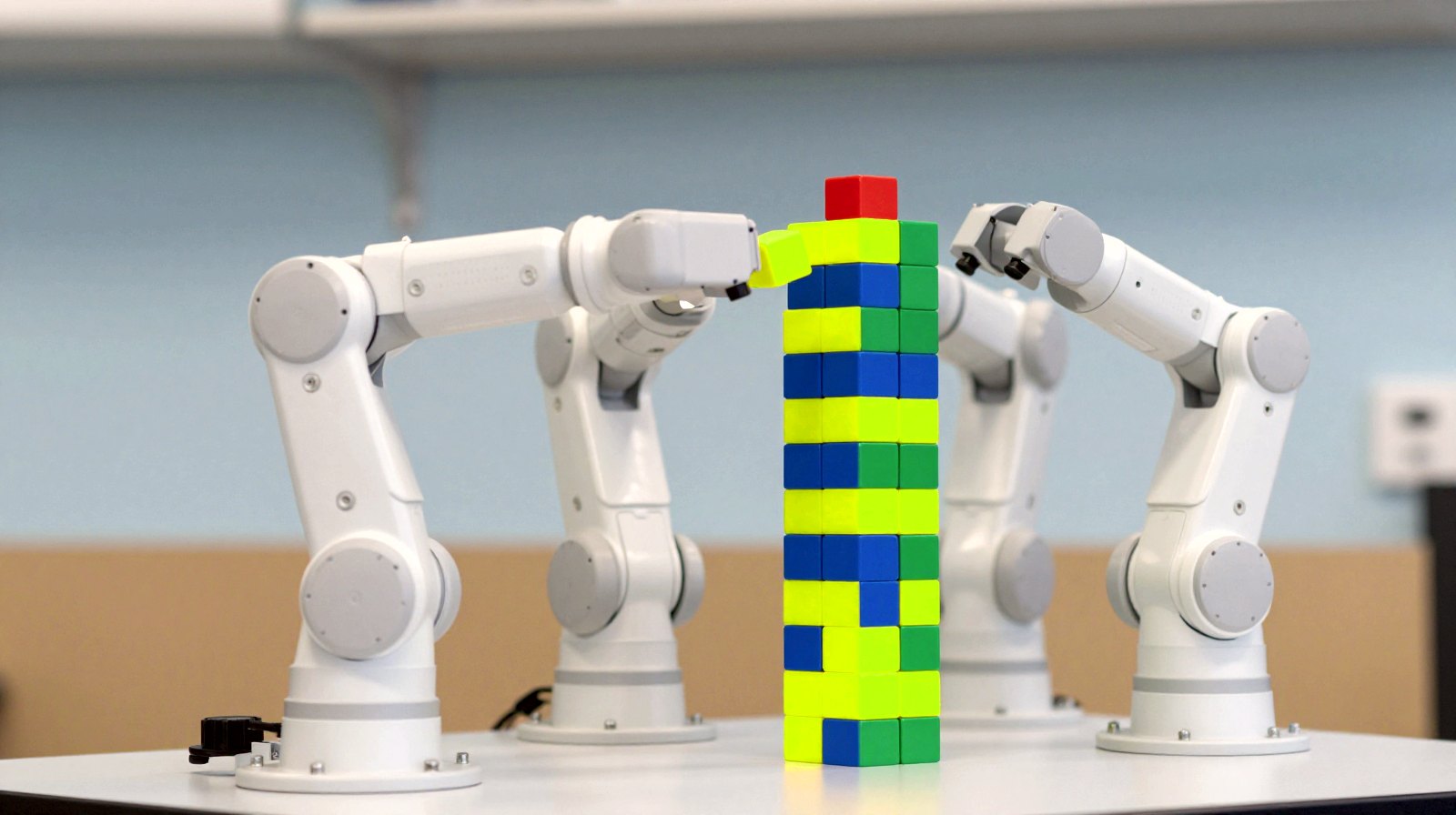
Four AI agents dropped into a brand-new Minecraft world with nothing but bare hands and one instruction, “defeat the Ender Dragon”, have done exactly that: 27 hours and 14 minutes later, with no human stepping in. The run is described in a new preprint by researchers that Tech Xplore identifies as a Google DeepMind team, who call it the first end-to-end autonomous completion of the game by AI agents.
Why it matters: beating Minecraft is not about reflexes. It is about keeping a plan alive across thousands of steps, over more than a day, while things keep going wrong. That is exactly the skill AI needs before we trust it with long, messy real-world jobs, such as maintaining big software projects. The authors make that link themselves.
Why Minecraft is a tough test
If you have never played: you start in a random world with nothing. To reach the final boss you have to punch trees for wood, craft tools, mine stone and iron, find diamonds, build a portal to a fiery dimension called the Nether, collect rare items there, craft special “eyes” to locate a hidden stronghold, place twelve of them in a portal frame, and only then face the dragon. Each step depends on the one before it. One bad decision early on can waste hours.
The paper’s own figure lists 13 milestones on the road from bare hands to the dragon.
How the agents played
The agents were copies of a large language model the paper calls Gemini 4 Argon. They did not see the game the way you do. Instead, each one controlled its character by writing JavaScript programs through Mineflayer, a free, open-source tool for controlling Minecraft bots. They read text updates about their health, inventory and position, and they talked to each other through the in-game chat and a shared memory.
- No training on the game: according to Tech Xplore, they were not trained on Minecraft gameplay and got no strategy or step-by-step guide. They leaned on what the model already knew and its general coding skill.
- No assigned roles: nobody told one agent to mine and another to fight. They split the work themselves through chat.
- A fair fight: a random survival world on Easy difficulty, cheat commands off, no pre-scouted world seeds and no human-written game-specific tools.
- A referee: a fifth agent watched to check progress and spot technical errors. Researchers followed on a live dashboard and could pause or stop the run, but, in the authors’ words, had no reason to intervene.
The numbers behind the win
Over the full run the team wrote 2,783 programs and their characters died 605 times. That last number is the interesting one. Dying is how the agents learned: after each death they came back, adjusted their plan and rewrote their code. The paper also describes them sharing what they learned and even recovering each other’s dropped items.
To see how fast this field is moving: in April 2025 the DreamerV3 system, published in Nature, made headlines as the first algorithm to collect diamonds in Minecraft from scratch without human data, a milestone roughly halfway along today’s route. That was a single agent learning by trial and error through rewards. This new run uses a very different recipe (language models writing code and coordinating as a team) and goes all the way to the end of the game.
The fine print
It was one run, the team’s first launch. The authors are clear that a single success does not show how reliably the setup works: run it ten times and it might win ten times, or twice. It is also a preprint, which means it has not yet been checked by independent reviewers. And because the agents act through code and text, they never had to master the game’s visuals the way a human player does.
Still, persistence over a full day of play, with 605 setbacks along the way, is a genuine step. It echoes what we saw when AI produced hundreds of machine-checked maths papers: the new frontier is not one clever answer but long chains of work that hold together.
What happens next
Expect more runs, harder difficulty settings and comparisons between AI models on the same task. Minecraft is becoming a public stress test for “agentic” AI, systems that plan and act on their own. The same questions apply far beyond games: how often do they succeed, how do they recover from mistakes, and when should a human step in? Those are also the questions behind recent incidents with AI agents going off-script.
Read next
- AI wrote 700 maths papers: what Lean proof checks really mean
- How close are we to AGI? Where things really stand in 2026
- OpenAI apologises to Australia after AI agents went off-script
Sources
- A team of Gemini 4 Argon agents beats Minecraft – M. Faldor, S. Singh, R. Raileanu, arXiv preprint, 15 October 2026
- AI slays the dragon as four agents conquer Minecraft without human intervention – Paul Arnold, Tech Xplore, 20 October 2026
- Mastering diverse control tasks through world models – D. Hafner et al., Nature, April 2025
- DreamerV3 project page – Danijar Hafner, 2025