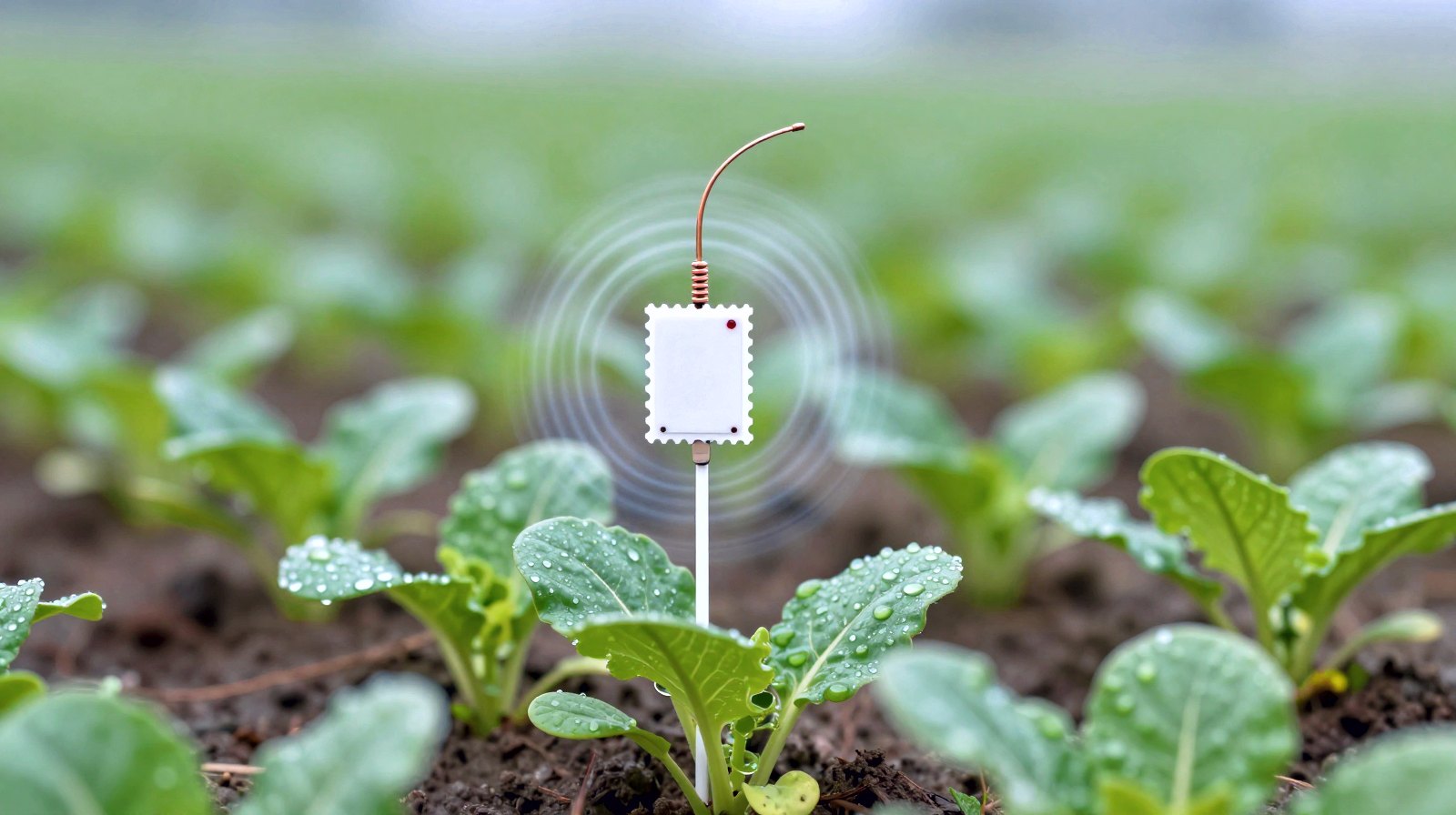
Every wire, every antenna and every circuit around you is fizzing with a faint electrical hiss called thermal noise. Engineers usually spend fortunes fighting it. Now a team at Stanford University has turned that hiss into a messenger: a tiny transmitter that sends data without producing any radio signal of its own, as described in a new paper in PNAS and reported by Tech Xplore.
Why it matters: billions of small sensors (in fields, factories, bridges and hospitals) only need to send a few numbers now and then, yet a normal radio transmitter is one of the hungriest parts of such a gadget. According to the Stanford team, a standard radio-frequency transmitter can use up to 1,000 times more energy to send the same information than a thermal-noise transmitter. Less energy means smaller batteries, longer lives, or no battery at all.
What is thermal noise, anyway?
Inside any conductor at room temperature, electrons never sit still. They jiggle about, and that random motion creates tiny voltage wobbles. Physicists call it Johnson or thermal noise. It is the soft hiss you hear from an old radio tuned between stations, and it is everywhere, all the time, for free.
The warmer something is, the “louder” its noise. That simple rule is the key to the whole trick.
How you send a message with static
The Stanford transmitter is almost absurdly simple. It is an antenna connected to a switch that flips between two states: an open circuit and a short circuit. One state means 1, the other means 0.
On the other side, the receiver amplifies the thermal noise bouncing back off the transmitter’s antenna. Depending on which way the switch is set, the antenna either soaks up that noise or reflects it, so the noise reaching the receiver looks slightly “hotter” or slightly “colder”. The receiver reads those tiny changes as a stream of ones and zeros, even though everything in the room stays at the same temperature.
Professor Joseph Kahn compared the transmitter to a castaway signalling with a hand mirror: it does not make light, it just redirects what is already there. “It’s just a reflector,” he said in Stanford’s announcement.
What is new in this paper
The idea is not brand new. In 2022, Zerina Kapetanovic, now an assistant professor at Stanford and the senior author of the new study, showed in an earlier paper with colleagues that modulated thermal noise could carry bits up to 26 bits per second over 7.3 metres, using about as little power as an RFID tag.
That first version worked, but nobody had a full recipe for why it worked as well as it did, or how to make it better. The new study, led by graduate students Geneva Ecola and Jida Zhang, builds a “first-principles channel model”: an equation that describes, from basic physics, how the transmitter, the antenna and the receiver’s amplifier shape the signal. Using that model to tune their setup, the team increased the data rate about 100-fold in their tests, according to Stanford.
For context, that is still a trickle, not a video stream. Think soil readings, temperatures or “door open” alerts, not music.
Where it could be useful
- Farm and environment sensors: Kapetanovic’s interest began with agricultural sensing, such as soil moisture probes that should run for years without a battery change.
- Places that hate radio interference: because the transmitter does not broadcast its own signal, the team sees uses near sensitive equipment such as medical devices or radio astronomy observatories.
- Tags and tiny relays: the inspiration was something like a motorway toll tag, but without the energy-hungry ping that wakes it up.
The catch
So far, the experiments ran inside a heavily shielded chamber that blocks outside radio signals. The real world is a noisy place, full of Wi-Fi, phones and microwaves, and the team says its next job is keeping the faint signal from getting lost out there. They are also working out how to link many transmitters into a network.
“We’re hoping that this unconventional communication system can unlock wireless communication where it hasn’t been able to go before,” Ecola said.
What happens next
Don’t expect a thermal-noise phone. Expect, perhaps in a few years, sensors the size of a stamp that whisper a handful of numbers a minute for a decade, powered by a speck of solar cell. If that sounds familiar, it is the same dream behind self-powered wearable sensors and longer-lasting batteries: make the electronics so frugal that power stops being the problem.
Read next
- Self-powered glasses sensors read your pulse, blinks and bites
- NTT moves data with light, not wires, inside AI data centres
- Washable circuit fibres: threads that glow, compute and sense
Sources
- First-principles channel model and capacity-achieving transmission scheme in thermal noise backscatter links – G. Ecola, J. Zhang, J. M. Kahn, Z. Kapetanovic, PNAS, 20 October 2026
- Thermal noise used to send data without an active signal – Stanford Report, October 2026
- Background static can carry wireless data without an actively generated radio signal – Tech Xplore, 20 October 2026
- Communication by means of modulated Johnson noise – Z. Kapetanovic, M. Morales, J. R. Smith, arXiv / PNAS 2022