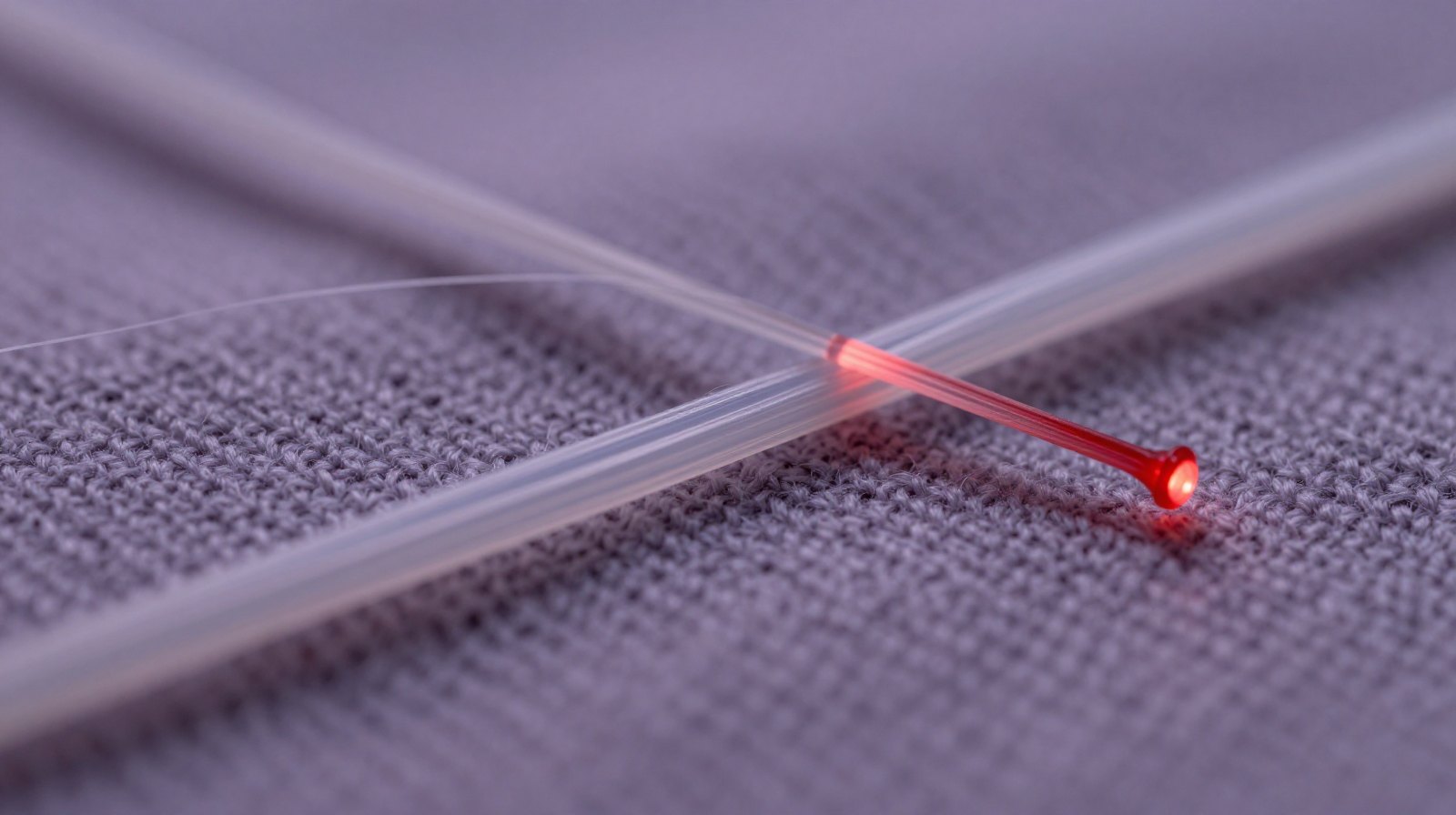
What if the thread in your jumper was the electronics, not just something to glue a chip onto? Researchers at Donghua University in Shanghai have built soft fibres with whole little circuits spun right inside them. Their threads can glow, filter signals, do simple logic and even sense a hand moving nearby without being touched, and they still work after being bent, stretched and put through a washing machine. The work is published in Nature Electronics.
Why it matters: most “smart clothes” today are ordinary fabric with small rigid chips and wires attached. The hard parts and the soft parts pull against each other, and the solder joints between them are where things break. Building the circuit into the fibre itself could make wearable electronics tougher, more comfortable and easier to wash.
From “circuit on a fibre” to “fibre as a circuit”
The team’s guiding question, as co-author Hengda Sun put it to Tech Xplore, was whether a soft fibre could be “more than a carrier for electronics” and become the circuit itself. Their goal, in their words, is moving from “circuit-on-fiber” to “fiber-as-circuit”.
Here is the idea in plain terms. A normal circuit is made of building blocks: wires that carry current, insulators that keep things apart, materials that light up and semiconductors that switch on and off. The Donghua team made liquid versions of all of these and learned to place them precisely inside one continuous, stretchy thread.

How do you “spin” a circuit?
The key tool is a microfluidic chip: a small block with tiny channels that guide liquids, a bit like a miniature plumbing system. This one has five channels. Each feeds a different liquid mix, all combined with a soft, elastic plastic called thermoplastic polyurethane (TPU, the same family of material used in flexible phone cases and some 3D-printing filaments). It all happens at room temperature, Tech Xplore reports.
Two kinds of control turn those liquids into circuits:
- Across the fibre, materials are stacked in layers, like the rings of a tree trunk, so each section becomes a device.
- Along the fibre, switching the flows on and off decides where each device starts, stops and connects to the next one.
So placing the materials, building the devices and wiring them together all happen in one continuous spinning step. Think of a piping bag that can switch icing colours mid-line, except the “colours” are electronic materials.
What the threads can do
According to the paper, the team built four kinds of fibre modules:
- Light-emitting fibres that glow when powered.
- Resistor and capacitor fibres (basic parts that slow down or store electric charge) for simple signal processing, combined into adjustable filters.
- Transistor fibres (the tiny switches behind all digital electronics) that perform simple logic, combined into inverters, a circuit that flips “on” to “off”.
- Touchless sensing fibres that notice a hand or object nearby through tiny changes in the electric field.
In demonstrations, those touchless fibres were connected to control systems to steer a drone and a robotic arm with hand gestures, and to track a moving target automatically, Tech Xplore reports. The fibres can be woven, sewn and arranged into fabrics, and the team checked them under repeated bending, stretching and standard machine washing.
What happens next
This is a research result, not a product, and the published coverage does not give figures such as how many wash cycles the threads survived. The researchers list the next hurdles themselves: reliable connections between separate fibres, avoiding signal “crosstalk” when many modules sit close together, and adding power supply and storage inside the fibres. They also want microfluidic chips with more channels and finer features, and to scale up from single threads to full garments.
For makers, it’s a good reminder of where e-textiles are heading. Today you can already sew conductive thread and small LED boards into a costume. Tomorrow, the thread itself might be the circuit, and you could simply throw it in the wash.
Sources
- Programmable spinning of integrated circuit fibres – F. Sun et al. (Donghua University), Nature Electronics, published online 23 September 2026
- New spinning method builds electronic circuits directly inside soft, washable fibers – Tech Xplore, 12 October 2026