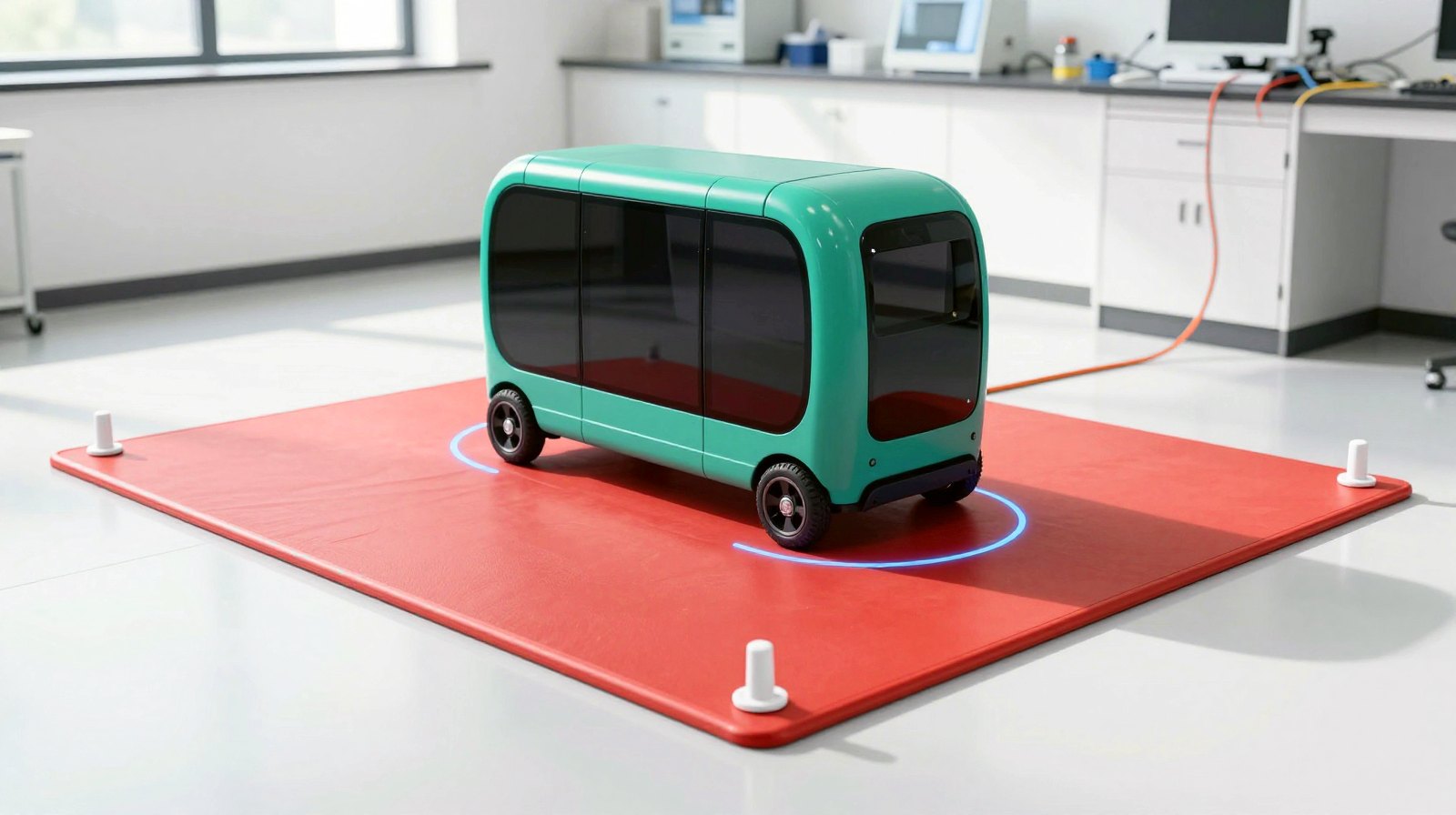
Engineers in Japan have found a way to tell an electric car exactly where it sits over a wireless charging pad, to within a couple of millimetres, using the same family of short-range radio found in some digital car keys. The system comes from the University of Osaka, working with the car-parts maker Tokai Rika and the University of California San Diego, the university announced on 11 November.
Why it matters: wireless charging sounds like the dream. You park, you walk away, the car fills up. But the coil under the car has to sit almost exactly over the coil in the ground. Miss by a few centimetres, or park a little crooked, and charging becomes less efficient and takes longer. A cheap, precise “you are here” signal is one of the missing pieces.
The parking problem nobody talks about
Wireless charging for cars works like the pad for your phone, only bigger. A coil in the ground creates a magnetic field, and a receiver coil under the car turns it back into electricity. The two coils need to face each other squarely.
Today’s ways of lining them up each have a weak spot. Magnetic positioning works best only when the car’s coil is already close to the pad. Cameras struggle with rain, dirt and poor light, which is a fair description of most car parks.
Radio that measures in millimetres
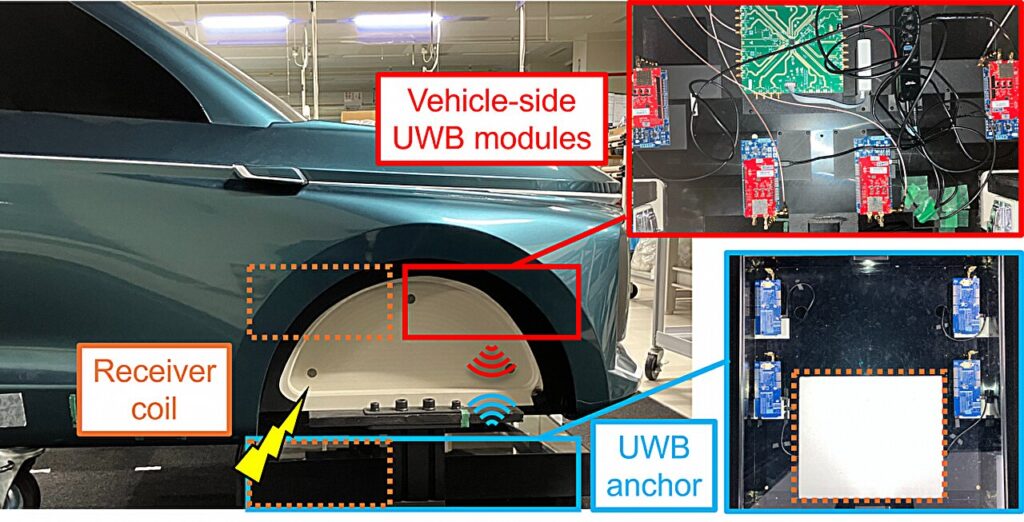
The Osaka team used ultra-wideband radio, or UWB: very short radio pulses that are good at measuring distance. Four small UWB devices sit around the receiver coil on the vehicle. On the ground, an anchor unit with four antenna elements surrounds the charging pad.
The system then works in three steps, according to the university:
- Rough position: it times how long the radio signals take to travel between car and pad. That gives an approximate location.
- Fine position: it compares the phase of the waves, meaning the tiny differences in how each wave arrives at each device. That sharpens both the position and the direction the car is facing.
- Clean-up: every installation bends the signals a little in its own way. Those distortions are measured in advance and subtracted.
The numbers
In lab tests with a scaled-down vehicle mockup, the typical (median) position error was 2.32 millimetres, about the thickness of a coin. The typical error in the car’s heading was 0.25 degrees. Without the clean-up step for phase distortions, the position error was about five times larger, Tech Xplore reports.
The work is described in a peer-reviewed paper, “Toward Precise Pad-to-Coil Alignment in EV Inductive Charging With UWB“, published in the IEEE Open Journal of Vehicular Technology on 26 August. First author Ryotaro Hada says that turning the maths into a working system took “considerable trial and error”.
Should you get excited?
A little, with patience. This is a lab result, not a product. The tests used a mockup, not a full-size car, at one fixed stopping position, indoors, and without power actually flowing through the coils. The researchers say full-size vehicles, outdoor conditions and real power transfer still have to be tested.
Who is it for? In the long run, anyone who would rather not wrestle a cable in the rain. But the first winners are likely to be cars with no driver at all. A robotaxi cannot plug itself in. If it can park itself over a pad with coin-thickness accuracy, it can recharge without a human anywhere near it, which is exactly the use the team highlights.
The position information can also be shown to a driver as a parking guide. The team hopes for a future where electric cars charge simply by parking, much as a phone charges when you drop it on a pad.
Charging is only half of the electric-car story, of course. The other half is under the bonnet: here is how Mercedes’ axial-flux motor gets more torque from a thin disc.
What happens next
Watch for three things: tests on a real car, tests outdoors, and tests while the pad is actually delivering power. If the millimetres survive all three, “just park” charging gets a lot closer.
Read next
- New Mercedes Axial-Flux Motor: more torque from a thin disc
- Why the power grid hiccups every minute: batteries on a clock
- Spanish team builds a rechargeable battery with vitamin B12
The week's best tech stories, free
One email a week with the stories that matter, explained simply. No spam.
Sources
- Radio waves pave the way for effortless EV charging, The University of Osaka via EurekAlert!, 11 November 2026
- Radio waves pave the way for better wireless EV charging, Tech Xplore, 12 November 2026
- Toward Precise Pad-to-Coil Alignment in EV Inductive Charging With UWB, Hada et al., IEEE Open Journal of Vehicular Technology, 26 August 2026