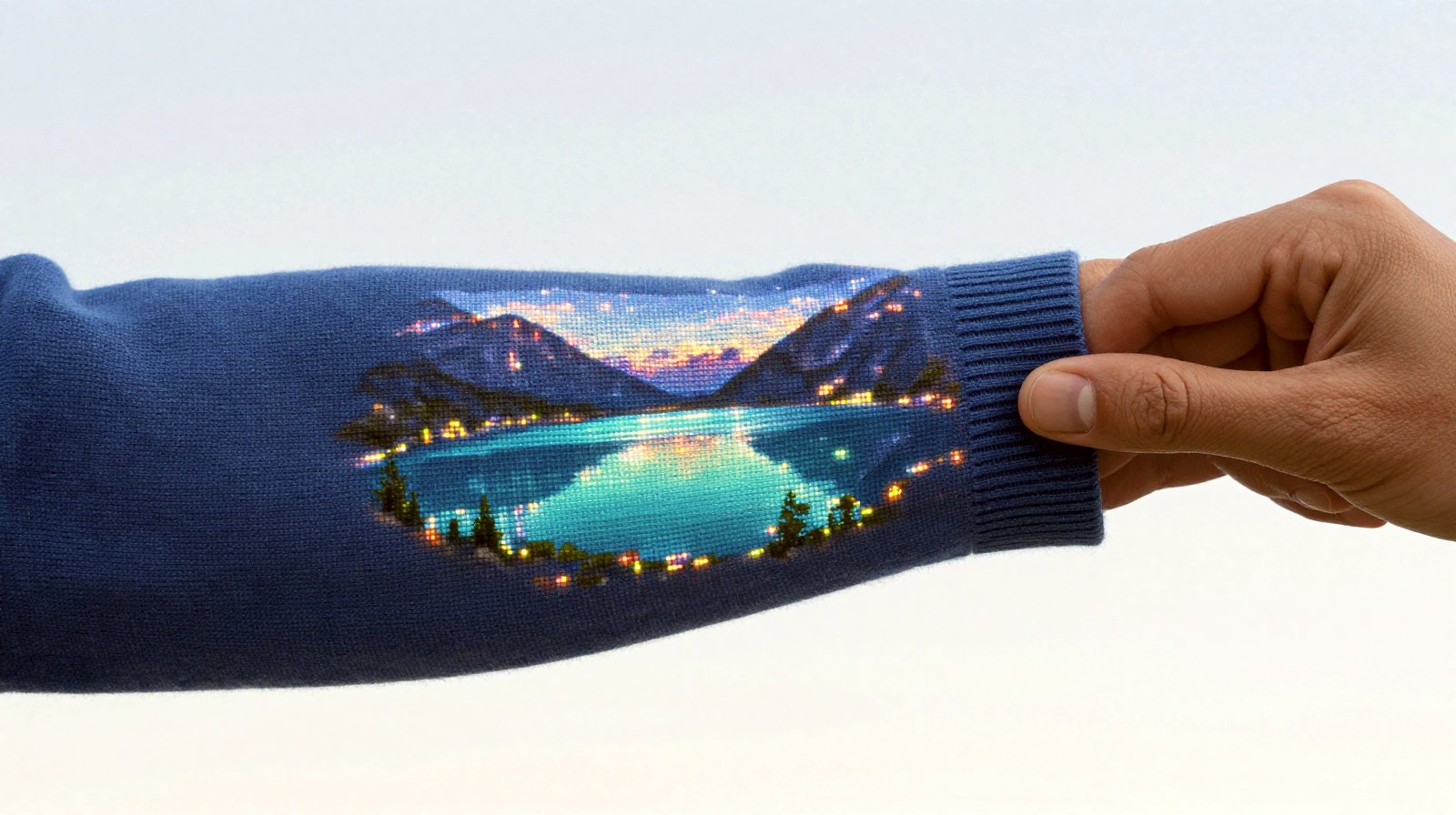
Imagine checking a map, a photo or your temperature by tapping your own sleeve. Researchers at the National University of Singapore (NUS) have built the first touchscreen made entirely from threads and woven into a garment: a working sleeve display that shows video, runs a calculator and reacts to your fingers, they report in Nature.
Why it matters: smart clothing has so far meant a sensor or two sewn into fabric. This is a full screen you can touch, wash and wear, built the way clothes are built, from fibres. It moves “wearable tech” from the wrist onto everything we already wear.
A pixel and a fingertip sensor in one thread
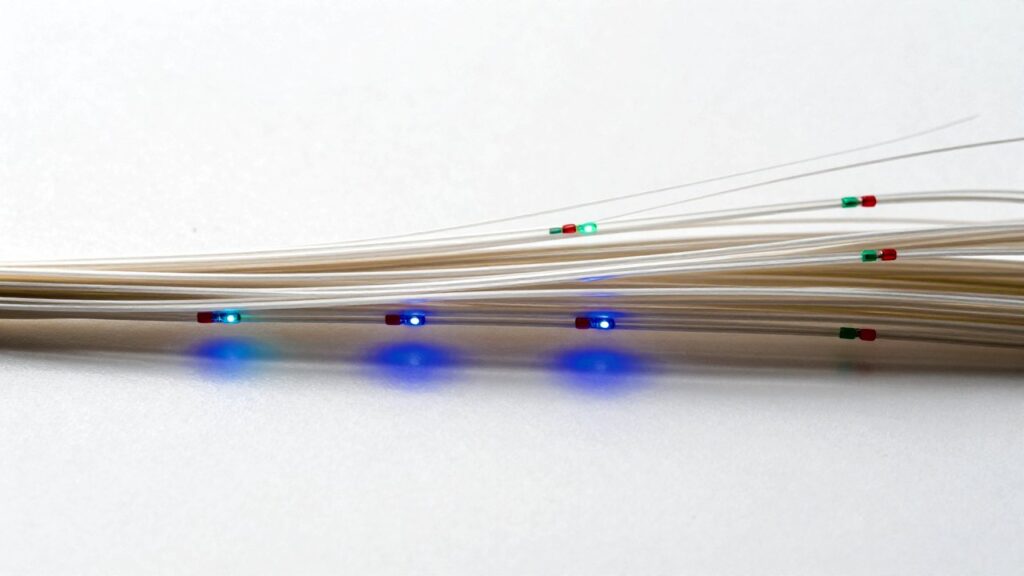
The trick is a special fibre, about 1 mm thick and 10 metres long, that is both a row of pixels and a touch sensor. Each fibre carries 96 tiny LEDs (light-emitting diodes, the little lights in every modern screen), and a layer underneath them senses pressure. Press the fabric and you close a tiny circuit; the signal tells the fibre where your finger landed, and the nearest pixel lights up, according to the NUS announcement on Tech Xplore.
Making it was the hard part. Electronics are normally built on flat boards, but a thread is long and round. “A fiber has a one-dimensional, axially symmetric geometry,” explains Assistant Professor Tural Khudiyev, who led the work. The team used a laser to mark connection points along insulated wires so that molten solder only sticks where it should. That way they wired more than 5,000 chips through over 20,000 electrical connections.
What the sleeve can do
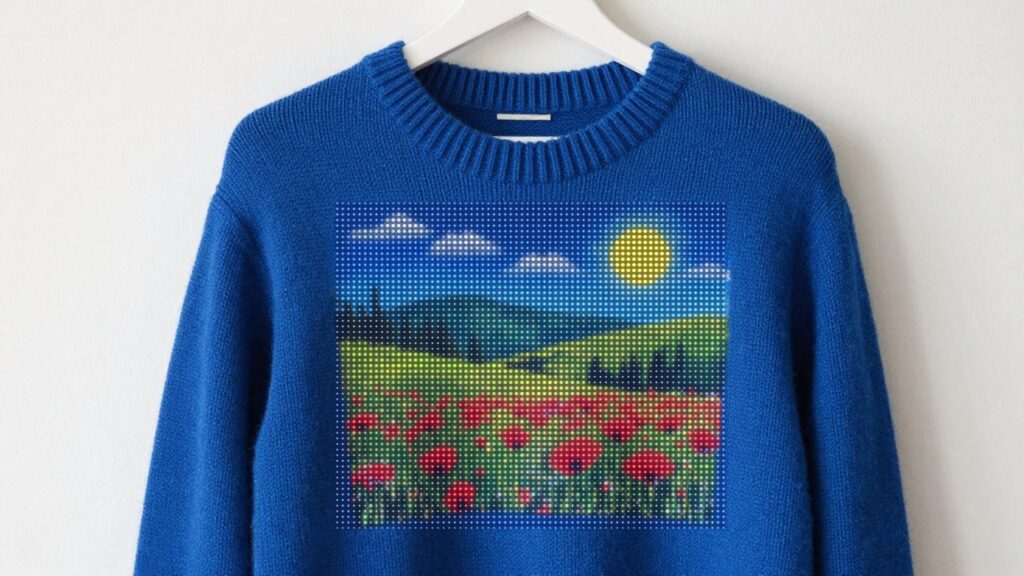
The prototype lines up 54 of these fibres into a 96 by 54 pixel display, 168 by 105 mm, a little wider than a large phone. It refreshes 30 times a second with 8-bit colour. Each fibre has its own control channel, so if one fails the rest keep working, and the screen can register several touches at once.
Extra fibres around the edge carry a microphone, a speaker and sensors for movement, direction, temperature and light. Together they let the sleeve run a calculator, a photo gallery, video playback and a compass, respond to voice commands, receive pictures over Bluetooth, turn and dim the picture automatically, and show your body temperature when the temperature fibre sits under your arm, report Digital Trends and NUS.
Washable, bendable, breathable
Clothes have a tough life, so the team tortured the sleeve. Light output and touch response were nearly unchanged after 50 detergent washes in an ordinary washing machine and after 1,000 bends around a 5 mm curve, both sources report. NUS adds that the display breathes about as well as cotton, polyester and denim.
Should you wait for a touchscreen jacket?
Not yet. This is a lab prototype, and its resolution is modest: 96 by 54 pixels is far coarser than any phone. Digital Trends notes that no product has been announced and that there is a long way to go before touchscreen clothing is common.
Still, the direction is clear. Smaller chips and thinner fibres could bring sharper, bigger displays that standard knitting, weaving and embroidery machines can handle. Khudiyev calls health care “one particularly promising application”: clothes that quietly track your body and show you the result right on the fabric.
What happens next
The team’s next goals are higher resolution, more built-in sensing and AI running on the garment itself. If threads can already compute, glow and sense, as we saw with washable circuit fibres, a shirt that doubles as a screen no longer sounds like science fiction.
Read next
- Washable circuit fibres: threads that glow, compute and sense
- Self-powered glasses sensors read your pulse, blinks and bites
- A screen that plays sound exactly where you see it
The week's best tech stories, free
One email a week with the stories that matter, explained simply. No spam.
Sources
- Researchers thread the world’s first touchscreen into a garment – Tech Xplore (National University of Singapore), 22 October 2026
- This touchscreen is made from thread, and scientists want to put it in your clothes – Digital Trends (Varun Mirchandani), 22 October 2026
- Touch-sensing digital pixel fibre enables interactive garment GUI – Nature (Fu, Khudiyev et al.), October 2026