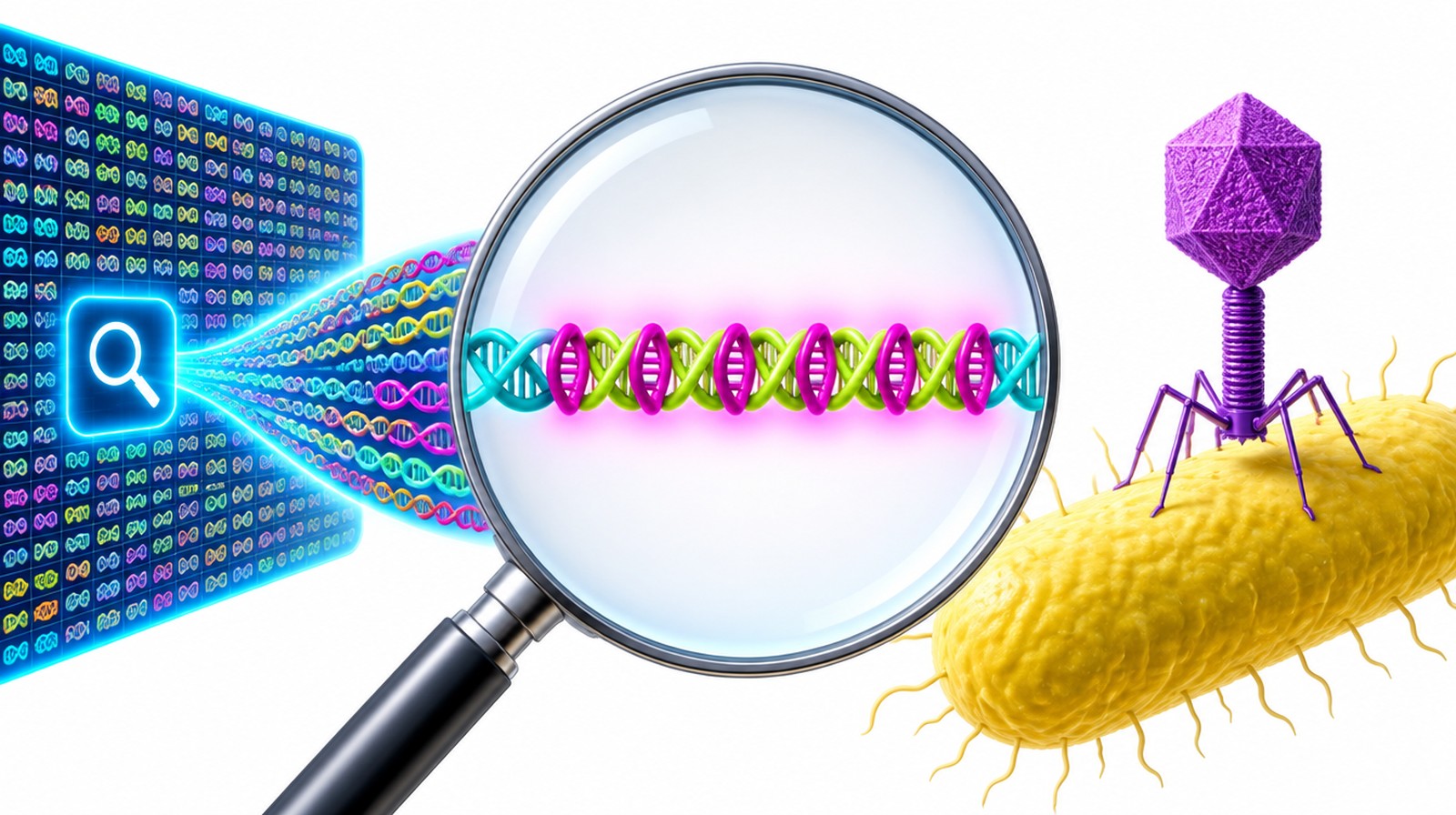
An AI has found a new biological machine hiding in the DNA of viruses, and it looks a lot like CRISPR, the gene-editing tool that won a Nobel Prize. Anthropic says a team of its Claude AI agents spotted the system, now called ART (array-associated reverse transcriptases), and the company’s scientists then started testing it in the lab, Anthropic announced on 23 September.
Why it matters: CRISPR came from studying how bacteria defend themselves against viruses, and it changed medicine and farming. Nature is full of similar tiny machines that nobody has found yet. If AI can search for them faster than people can, the next great biology tool could come out of a computer search. But nobody knows yet what ART actually does, so it is a promising clue, not a new gene editor.
First, what is CRISPR?
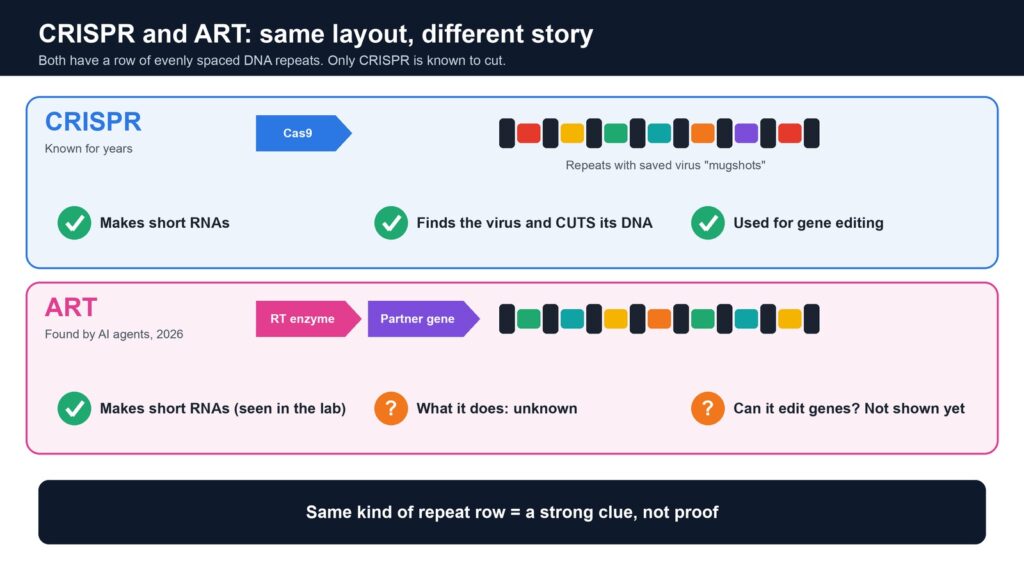
CRISPR is a natural defence system in bacteria. When a virus attacks, the bacterium saves a short piece of the virus’s DNA in a special place in its own DNA: a long row of repeated sequences with the saved pieces in between, like mugshots pinned on a wall. Next time the same virus shows up, the bacterium makes RNA copies of those mugshots, and a cutting enzyme (Cas9 is the most famous) uses them to find the virus and chop it up.
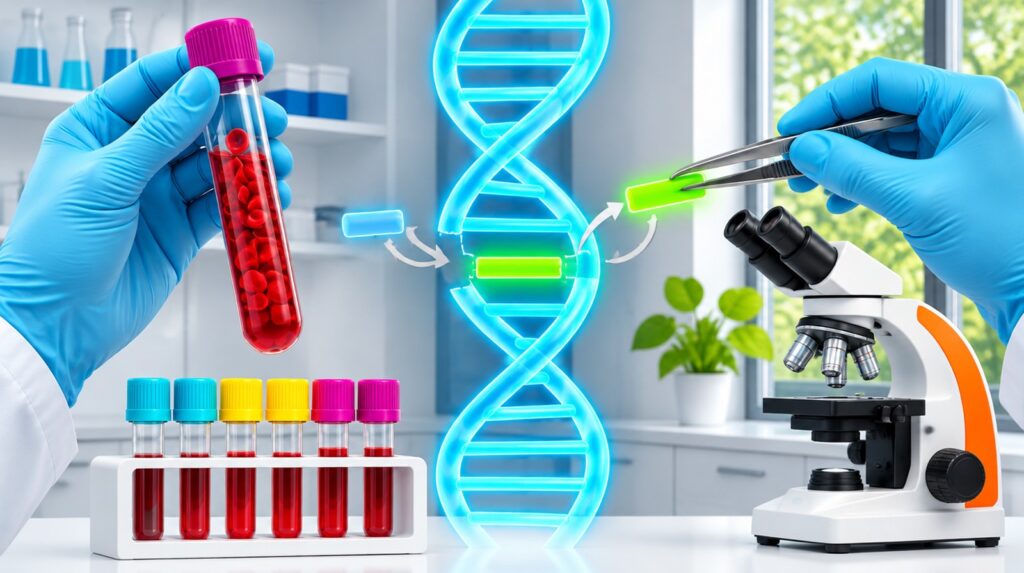
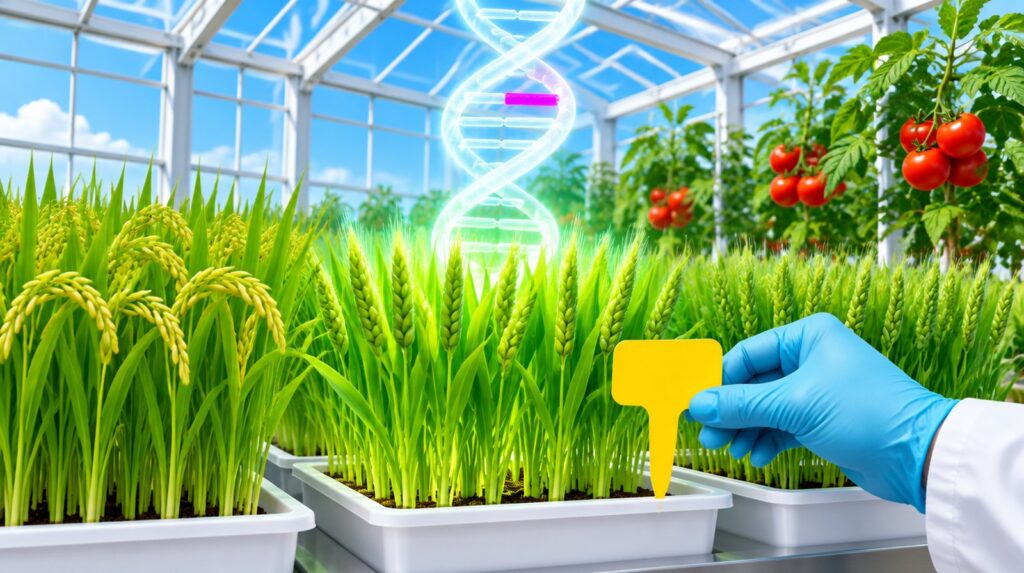
Scientists learned to give that cutting enzyme their own “mugshot”, so it cuts exactly the DNA they choose. That is how CRISPR became a gene-editing tool, now used in medicine and in crop research.
What the AI found
ART has three parts: an enzyme called a reverse transcriptase (it turns RNA back into DNA), a partner gene sitting next to it, and a long array of evenly spaced DNA repeats. That repeat array is what makes scientists think of CRISPR. ART lives mainly in bacteriophages, viruses that infect bacteria; Gizmodo reports it was found in phages of Staphylococcus bacteria.
The enzyme itself was already known from earlier studies. What is new, according to Anthropic, is that Claude seems to be the first to notice the repeat array and the partner protein, which together suggest the enzyme is part of a bigger machine.
How the AI searched
The humans only wrote the starting brief: look for new reverse transcriptases in a huge DNA database. Then about 950 Claude agents worked for 21 hours. They gathered more than 200,000 reverse transcriptases, picked out 3,500 candidate systems and wrote detailed reports on the 20 most interesting, Anthropic says. One agent noticed the strange repeat pattern in the raw DNA, checked the scientific literature and flagged it.
Anthropic’s scientists then did the lab work. Early experiments showed that the ART repeat array is read out as many separate short RNAs, which is also how a CRISPR array behaves. Anthropic notes that the few known systems with this combination of features can be programmed to cut, copy or paste DNA, but ART has not been shown to do any of that.
Why it could be important
- A possible new tool. Anthropic CEO Dario Amodei wrote that ART “could represent a new gene editing mechanism.” Many of today’s best tools, CRISPR included, came from bacteria and viruses.
- Faster discovery. Anthropic says this kind of search can take human researchers weeks to months. AI agents can run huge exploratory searches, check the literature and decide which leads deserve a lab test.
- Science by AI agents. Writing in The Conversation, computer scientist Dimitri Perrin says the real step is autonomy: the AI chose which analyses to run and which result was worth testing.
The careful part
Experts are cheering, but slowly. CRISPR pioneer Feng Zhang, who reviewed the preprint for Anthropic, called it “an exciting example of how AI agents can contribute to biological discovery.” Kevin Blake of Washington University told Gizmodo there is nothing to suggest it is a rival to CRISPR as a technology. In The Conversation, Perrin adds that ART is CRISPR-like in its layout, with no evidence yet that it works the same way, and that a classic search program might have found the same pattern.
The work is a preprint, not yet peer reviewed. All lab work is done by human scientists in a lab that, according to Anthropic, does not handle germs that infect people. AI agents that know when to hand over to a human are a growing field too: read our story on AI agents that ask for help.
What happens next
The big question is simple: what does ART do in nature, and can it be programmed? Anthropic says experiments are under way and it is inviting other scientists to suggest research questions. If ART turns out to cut or copy DNA on command, it could join CRISPR in the toolbox. If not, it is still a new piece of life’s machinery, found by an AI.
AI courses on Udemy, from the basics to building your own apps, at your own pace.See courses with the discount →Best AI certifications →
Read next
- One AI learns to simulate sand, water, cloth and proteins
- Robot thinks a chimney is a squirrel, then fixes its own memory
- Electronic implant turns excess blood sugar into waste, in mice
The week's best tech stories, free
One email a week with the stories that matter, explained simply. No spam.
Sources
- Claude discovers a novel enzyme system, Anthropic, 23 September 2026
- An AI model has found a new ‘CRISPR-like’ biological system. Here’s what it means for science, Dimitri Perrin, The Conversation, 24 September 2026
- Claude Found a Mysterious CRISPR-Like System, but Anthropic Can’t Say What It’s Capable of, Gizmodo, 24 September 2026
Disclosure: this article contains affiliate links
If you buy through them, WOXTER AMERICA LLC may earn a commission at no extra cost to you. Our picks are based on specifications, prices and published reviews, not on any payments.