Disclosure: this article contains affiliate links to online courses. If you sign up through them, DIGITAL WOXTER TECHNEWS may earn a commission at no extra cost to you. We choose courses for their content, not for payments.
An AI model just dropped more than 700 maths papers on the world at once, and mathematicians are not throwing a party. On 6 October, OpenAI posted 722 manuscripts written by an unreleased internal model, claiming answers to 377 open questions from almost every corner of mathematics, as Quanta Magazine and Interesting Engineering report. Many come with a computer-checked proof written in a language called Lean.
Why it matters: if machines can produce correct new mathematics by the hundreds, research in maths, physics and computer science could speed up enormously. But a proof is only useful if people can trust it and learn from it, and that is exactly where the arguments start.
What OpenAI actually released
The papers sit in a public GitHub repository, grouped into 372 research families spanning number theory, geometry, theoretical computer science and mathematical physics, according to Interesting Engineering. The model tried roughly 4,000 problems and failed on most of them, notes Quanta.
Surprisingly, most wins were cheap. OpenAI says an average result took the equivalent of about three hours of ChatGPT Pro thinking time, a figure both outlets repeat. That is less than an afternoon of a mathematician’s time, for a problem that may have sat unsolved for years.
What is Lean, and what does “checked” mean?
Lean is a programming language built for proofs. You write every logical step in a strict, formal way, and the computer refuses to accept the proof unless each step follows from the one before. Think of it as a spell-checker for logic that never gets tired and never skips a line.
OpenAI first said about half of the papers had been formally verified in Lean. A few days later the figure it gave was about 42%, “and climbing”, as Quanta and Tech Insider both report. Three algebraic geometry papers were withdrawn over a misplaced minus sign, leaving 719.
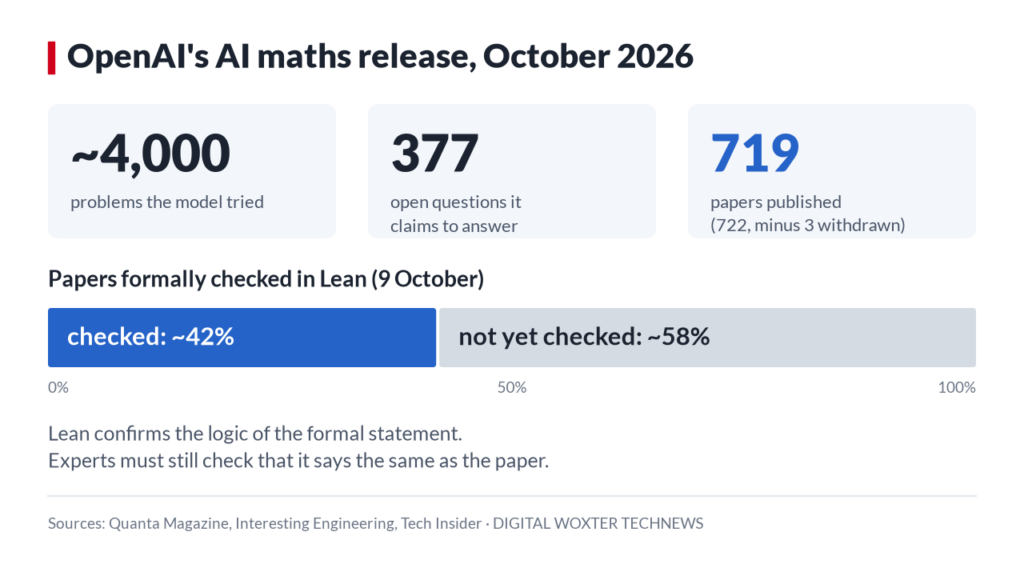
Here is the catch that everyday coverage often misses: Lean checks that the proof proves the statement written in Lean. A human still has to confirm that the Lean statement says the same thing as the claim in the paper. Johan Commelin of the Mathlib Initiative told Quanta that this translation “needs human experts to read the Lean code”, and he suspects some formal versions prove weaker statements than the headlines claim. Interesting Engineering adds the same warning: Lean checking does not automatically confirm every claim.
Why many mathematicians are upset
The reaction split the field. On 7 October a group called the Association for Human Mathematics published a statement rejecting the release; it said dumping more than 700 files at once is “not a demonstration of scholarship”, as Futurism reports. Quanta counts over 800 signatories, including Fields medallist Peter Scholze, and both outlets note that Terence Tao, one of the world’s best-known mathematicians, shared the statement.
The worries are practical, not just pride:
- Checking takes time. Experts quoted by Quanta say several papers are too vague to check, or hard to read, even when the idea inside is new.
- Understanding is the point. Mathematicians value a proof for the new ideas it teaches. A correct answer nobody understands adds less to the subject.
- Credit and norms. Who gets credit, and how should AI results be published? The community has no shared rules yet.
Others are calmer. Jordan Ellenberg of the University of Wisconsin told Quanta: “There’s no hurry and it will all get done.” Daniel Litt of the University of Toronto suggests treating the papers as raw research data rather than finished results.
Money to help humans keep up
On 15 October the Simons Foundation launched a $15 million effort, with Anthropic and OpenAI as partners, to help mathematicians examine AI-assisted results, learn the new tools and agree on community standards. YourStory reports the same figure and partners. Both AI companies will also give computing time to researchers the foundation supports.
What happens next
Expect months of careful reading: experts will pick through the papers that matter most, test the Lean statements and decide which results really are new. Watch for three signals: whether the verified share keeps rising, whether journals accept any of these papers, and whether OpenAI releases the model itself, which it says it plans to do once it considers it safe.
For the rest of us, the lesson is simple and useful: “the computer checked it” is powerful, but only if someone checks what the computer was asked to check.
Learn it yourself
Want to go further? These online courses cover the skills behind this story:
- Logic Brilliant: Interactive beginner puzzles on deduction, logical operators and quantifiers: the habits of thinking behind every proof.
See the course on Brilliant
Read next
- How close are we to AGI? Where things really stand in 2026
- AI agents now find zero-days, for attackers and defenders
- Brilliant app guide: learn the science behind tech by doing
Sources
- Transformation (AI and mathematics updates) – Quanta Magazine, updated October 2026
- OpenAI’s largest math release tackles 4,000 problems with Lean proofs – Interesting Engineering, 6 October 2026
- OpenAI math papers clear Lean checks at just 42% – Tech Insider, October 2026
- Mathematicians react with fury as OpenAI releases hundreds of new AI-generated proofs – Futurism, 9 October 2026
- Simons Foundation launches $15M effort to help mathematicians navigate AI era – Simons Foundation, 15 October 2026
- AI in mathematics gets $15M push from Simons, OpenAI and Anthropic – YourStory, October 2026