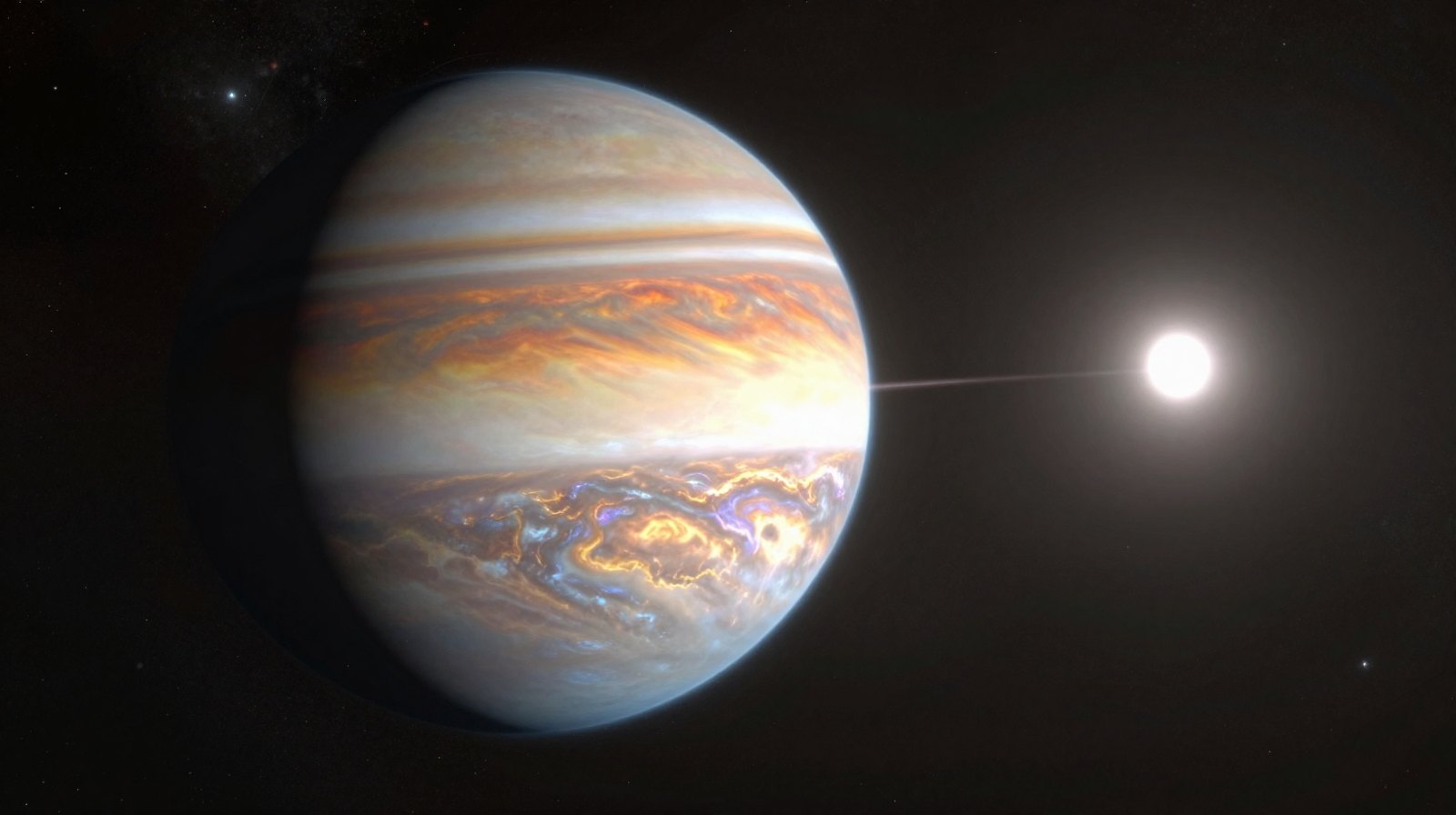
Astronomers think they may have found a planet that was born after its star died. The clue was hiding in Hubble data recorded in 1999: about 100 mystery fingerprints of light that nobody could name. Twenty-seven years later, a PhD student at the University of Warwick matched many of them to a rare metal, niobium, and that metal points to a giant planet built from the ashes of a dead star, according to a study published on 5 October in Nature Astronomy.
Why it matters: every planet we know, Earth included, formed from the leftovers of a star’s birth. A “second-generation” planet, made from the leftovers of a star’s death, has been predicted for years but never clearly caught. If this one is confirmed, dying stars are not only the end of a planetary story. They can also be the start of a new one.
A 27-year-old cold case
In 1999 Hubble pointed at a white dwarf called HS 0209+0832, about 270 light-years away in the constellation Cetus. It split the star’s light into a spectrum (a barcode of light where each dark line is the fingerprint of a chemical element). Roughly 100 of those lines matched nothing in the catalogues of the time, ESA/Hubble and NASA report.
The data simply waited in the archive. Then Jamie Williams, a doctoral candidate at Warwick, reopened it armed with an updated chemical database, and niobium matched many of the mystery lines. Data from FUSE, a retired NASA ultraviolet telescope, showed strong niobium signatures too. That is the quiet magic of space archives: a measurement taken before many of today’s students were born can solve a puzzle once the tools catch up.
What a white dwarf is, and why niobium is the clue
A white dwarf is what remains when a star like the Sun runs out of fuel: its glowing core, roughly the size of Earth, slowly cooling for billions of years like an ember after a campfire. This one is young and fierce. It became a white dwarf only about 5 million years ago and its surface is around 35,000 °C, more than six times hotter than the Sun’s, according to Sci.News and ScienceAlert. If Earth’s whole history were squeezed into one day, 5 million years would be the last minute and a half.
Here is the detective’s key insight. A white dwarf’s gravity is so strong that heavy elements in its atmosphere sink down out of view, as Science News explains. So if we can see heavy metals on the surface, fresh material must still be falling in. And this star has a lot: niobium more than 1,000 times more abundant than in the Sun, plus unusual amounts of zinc, copper and nickel. Co-author Boris Gänsicke says niobium had not been reported in any other white dwarf analysed so far.
The recipe matters. Ordinary rocky debris around white dwarfs is rich in silicon and iron. This mix looks instead like the elements a swollen, dying giant star cooks up, by slowly adding neutrons to atoms over thousands of years and then blowing them out into space.
A planet built from a star’s ashes
The team’s best explanation goes like this. When the star was dying, it shed its outer layers. Some of that enriched material formed a disc, and a gas giant grew inside it. Today the scorching white dwarf blasts that planet with ultraviolet light, boiling off its outer atmosphere. Part of the escaping gas falls back onto the star, which is exactly what Hubble saw.
NASA’s TESS satellite watched the star for four months and found a faint brightness change repeating every 4.4 days, consistent with a Jupiter-sized planet in a very tight orbit. It sits about 6 million kilometres from the white dwarf, roughly ten times closer than Mercury is to the Sun. A whole “year” there lasts less than a working week.
Be clear about what is measured and what is inferred. Measured: the niobium lines (Hubble and FUSE) and the repeating 4.4-day signal (TESS). Inferred: that a planet causes both, and that it formed from the star’s remains. The team itself calls the planet a candidate, not a confirmation, although Williams told Science News that a planet is “the most reasonable explanation”.
What it could mean for our Sun
In billions of years, the Sun will also become a white dwarf; Williams told Reuters that more than 95% of the stars in our galaxy will end up the same way. Could our Solar System grow a second-generation planet one day? Gänsicke asks exactly that question in the University of Warwick release, and Williams told Science News he thinks it is “definitely possible”. Nobody knows yet: this is one candidate around one star.
What happens next
The planet still has to be confirmed. Williams plans to use Hubble over the next several years to study how second-generation planets form, how common they are and how they evolve, and the team told Reuters it hopes to use the James Webb Space Telescope to check its conclusions. Meanwhile, astronomers will be combing other old datasets: the next cold case may already be sitting in an archive.
Sources
- Suspected second-generation planet solves Hubble cold case (heic2613) – ESA/Hubble, 5 October 2026
- Suspected Second-generation Planet Solves NASA Hubble Cold Case – NASA, 5 October 2026
- Discovery of a second-generation planet candidate accreting onto a white dwarf – J. T. Williams et al., Nature Astronomy, 5 October 2026
- The phoenix planet: astronomers find a world ‘reborn’ from its star’s ashes – University of Warwick, 5 October 2026
- A ‘phoenix’ planet was born from the ashes of its dead star – Science News, 5 October 2026
- Alien ‘phoenix planet’ was born from the ashes of a dying star – Reuters (via KSL), 6 October 2026
- Astronomers Spot Possible Second-Generation Planet around Young White Dwarf – Sci.News, 7 October 2026
- ‘More might be out there’: a scorching ‘phoenix planet’ may solve a 3-decade-old astronomical cold case – ScienceAlert, 8 October 2026