
Our Solar System may have just gained a new member. Astronomers using the brand-new Vera C. Rubin Observatory have found an icy world beyond Neptune, called 2026 ED138, that is somewhere between 600 and 1,500 kilometres across. If it turns out to be round, it would become only the sixth official dwarf planet, after Pluto, Ceres, Eris, Haumea and Makemake, as the Rubin team announced on 27 October.
Why it matters: the outer Solar System is dark, cold and enormous, and big worlds out there are rare and hard to spot. This is the first dwarf planet candidate from Rubin, a telescope built to photograph the whole southern sky again and again. Finding one this large so early hints that our map of the neighbourhood is far from finished.
A needle in a haystack of moving dots
The find started with software, not with someone at an eyepiece. Matthew Holman of the Center for Astrophysics | Harvard & Smithsonian ran Rubin images taken earlier in 2026 through a search program he wrote with his colleague Kevin Napier. The program sifts through billions of detections of things that move across the sky and works out which dots belong to the same object on the same path.
On the evening of 13 October, one path stood out. “My first reaction was one of excited disbelief,” Holman said in the announcement. Because objects like this are so rare, his next step was to check whether he or the code had made a mistake.
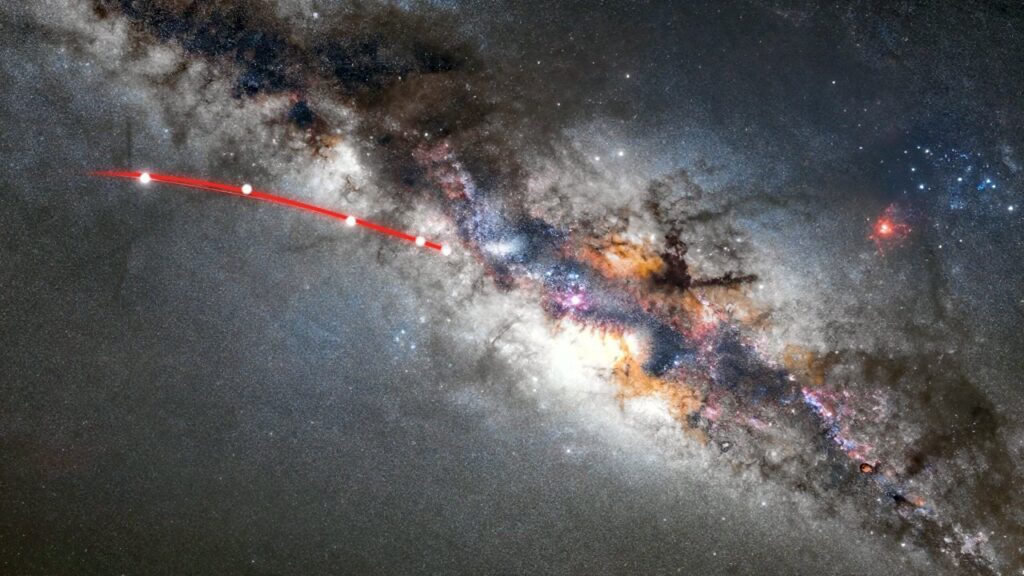
They hadn’t. Holman and Mario Jurić, the University of Washington astronomer who leads Rubin’s Solar System science, found that Rubin had already photographed the object 30 times on 20 different nights between March and July 2026. Older pictures from a camera called DECam, dug out of the archives with a “precovery” service run by the Asteroid Institute, go back to 2016. That gives the team more than ten years of its orbit.
Where it lives
2026 ED138 sits about 46 times farther from the Sun than Earth does (46 astronomical units, roughly 6.9 billion kilometres). Pluto, for comparison, averages about 40. Sunlight takes over six hours to get out there.
Its orbit is tilted almost 25 degrees to the flat plane in which the planets travel. Astronomers call objects like this “hot classical” members of the Kuiper Belt, the ring of icy leftovers beyond Neptune. That tilt suggests Neptune’s gravity knocked it off its original, flatter path long ago, Scientific American reports.
So why did nobody find it before? It travels through a crowded part of the sky near the plane of the Milky Way, where the light of millions of background stars drowned it out, the University of Washington explains. Rubin’s giant camera, which went into service only recently, is sharp and fast enough to pick it out.
Dwarf planet, or not yet?
For now, 2026 ED138 is a “dwarf planet candidate”. To earn the title, a world has to circle the Sun and be massive enough for its own gravity to pull it into a round shape (and, unlike a full planet, it hasn’t cleared its orbit of other objects).
The size range is wide because it is an estimate. The team worked it out from the object’s distance and brightness plus a guess at how reflective its surface is. A dark, dusty surface means a bigger world; a bright, icy one means a smaller one. Infrared telescopes, which measure the heat the object gives off, can pin down its true size and show whether it is round. Icy bodies this large are expected to be.
The discovery was made official by the International Astronomical Union’s Minor Planet Center, the global clearing house for new small bodies, and Holman and Jurić presented it at a planetary science meeting in Spokane, Washington, according to the Rubin announcement.
What happens next
Expect follow-up observations in infrared to measure the size, and more Rubin images to sharpen the orbit. If it is confirmed, the object will eventually get a proper name instead of its catalogue code.
And this is probably just the start. “Rubin will image the whole southern sky again and again for ten years,” Holman said. Every pass adds more moving dots for codes like his to connect, so more hidden worlds at the edge of the Solar System may be waiting to be found.
Read next
- Bennu samples reveal a hybrid asteroid born near the ice line
- Japan’s MMX launches to bring home soil from Mars’s moon Phobos
- First green star found: a dead star that glows chartreuse
The week's best tech stories, free
One email a week with the stories that matter, explained simply. No spam.
Sources
- NSF–DOE Vera C. Rubin Observatory reveals its first dwarf planet candidate in our solar system – SLAC National Accelerator Laboratory / Rubin Observatory, 27 October 2026
- The Vera C. Rubin Observatory may have just discovered our solar system’s sixth dwarf planet – Scientific American, 27 October 2026
- Rubin Observatory reveals its first dwarf planet candidate in our solar system – Phys.org (University of Washington), 27 October 2026