Shop for a new laptop today and one number keeps popping up next to the processor name: TOPS. 40 TOPS, 50 TOPS, 80 TOPS… and on 15 October a leaked spec sheet suggested Intel’s next desktop chips will reach 73. But what is a TOPS, why does Windows care about it, and does a bigger number really mean a smarter computer? Here is a simple guide.
What TOPS means
TOPS stands for “trillions of operations per second”. It counts how many simple maths steps (mostly multiplying and adding numbers) a chip’s AI engine can do every second. AI models are, at heart, giant piles of these small calculations, so more operations per second can mean faster AI.
The AI engine inside modern laptop chips is called an NPU (neural processing unit). Unlike the main processor (CPU) or the graphics chip (GPU), it is built only for AI maths, so it can run things like live captions, background blur on video calls or photo editing while using very little battery. Microsoft explains that Copilot+ PCs rely on an NPU that can perform more than 40 trillion operations per second, in its developer guide.
Why 40 is the magic number
Microsoft set 40 TOPS as the minimum for its “Copilot+ PC” label, the badge that unlocks Windows features designed to run on the NPU itself, such as Recall, real-time translated captions and image tools in Paint. That is why chip makers now print their TOPS proudly: falling below 40 means missing out on those features, as Microsoft’s guide and Engadget explain.
The 2026 scoreboard
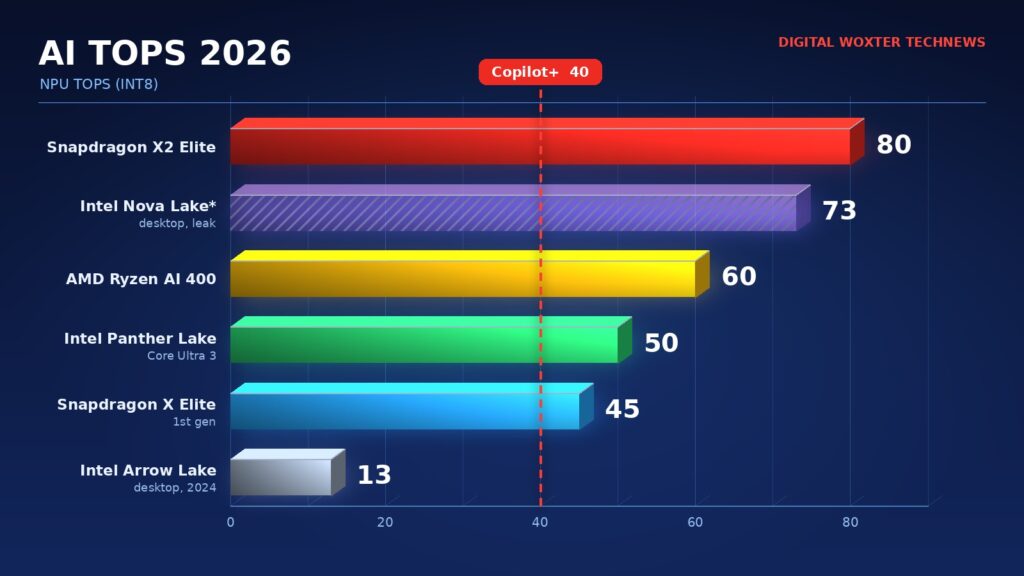
Here is where today’s main laptop chips stand, using each maker’s own maximum figure for the NPU:
- Qualcomm Snapdragon X2 Elite: 80 TOPS, up from 45 in the first generation, according to heise and Tom’s Guide.
- AMD Ryzen AI 400: up to 60 TOPS, per AMD’s CES 2026 announcement; the previous Ryzen AI 300 chips reached 50, notes Galaxus.
- Intel Core Ultra Series 3 (Panther Lake): 50 TOPS from the NPU. Intel also quotes up to 180 “platform TOPS” for its top chips, but that adds the graphics (about 122) and the processor together, so it isn’t comparable with an NPU-only number, as Ultrabookreview and Galaxus detail.
- Intel Nova Lake (desktop, coming): a specification table from Chinese motherboard maker Decenta lists 73 TOPS for the NPU, more than five times the 13 TOPS of today’s Arrow Lake desktop chips, Club386 reported on 15 October. An earlier leak pointed to about 74 TOPS, according to Wccftech. Intel hasn’t confirmed either figure.
Then there is Nvidia’s RTX Spark, which plays a different game. Nvidia talks about up to one petaflop (a thousand trillion operations per second) of AI power from its graphics part and didn’t give a number for the NPU; Microsoft only said it has enough TOPS to qualify as a Copilot+ PC, according to Engadget and PC-WELT.
The fine print behind the number
TOPS is useful, but it is a best-case figure. Three things to keep in mind:
- It’s a peak, not a promise. TOPS assumes every part of the chip is busy all the time. Real AI apps never use the whole engine like that; one engineer writing in EE Times noted that real efficiency can be as low as 10 percent, as Design & Reuse republished. AMD’s own footnote says its figure is the maximum in an optimal scenario.
- Number size matters. TOPS is usually measured with small 8-bit whole numbers (INT8). Use even smaller numbers and the TOPS figure goes up, so always check which format a company is quoting. Microsoft notes that many NPUs only handle this kind of low-precision integer maths, which is why AI models are “quantised” to run on them, in its guide.
- Dense or sparse. Some companies quote “sparse” TOPS, which assumes the chip can skip calculations with zeros. With a common sparsity method this doubles the figure, so sparse and dense numbers can’t be compared directly, Qualcomm explains in an article republished by the Edge AI and Vision Alliance.
Real tests show how little TOPS can tell you. In one comparison of two AI accelerators, one chip had about six times the TOPS of the other but ran real models around 13 times faster on average, CNX Software reported. Chip design, software and drivers matter as much as the headline.
So, should TOPS decide your next laptop?
Use it as a first filter, not the final answer:
- Want the new Windows AI features? Look for 40 TOPS or more and the Copilot+ PC label. Every current Snapdragon X2, Ryzen AI 400 and Core Ultra Series 3 laptop clears that bar.
- Want to run big AI models yourself? Memory and the graphics chip matter more than NPU TOPS, which is why machines like RTX Spark pair a powerful GPU with lots of shared memory.
- Everyday use? Battery life, screen and price will affect you far more than the difference between 50 and 80 TOPS.
TOPS is the horsepower figure of the AI era: handy for comparing engines, but nobody buys a car on horsepower alone.
Read next
- Nvidia RTX Spark: laptops that run big AI models offline
- Rapidus 2nm: Japan’s bid to build the world’s tiniest chips
- Boiling coolant inside chips: a safer way to tame AI heat
Sources
- Copilot+ PCs developer guide – Microsoft Learn, updated August 2026
- NVIDIA’s RTX Spark is an AI “superchip” that will power Windows laptops and desktops – Engadget, 1 June 2026
- Nvidia zeigt KI-Laptops der Zukunft – doch eine Frage bleibt offen – PC-WELT, 1 June 2026 (in German)
- Snapdragon X2: Qualcomm presents the second generation of its notebook processor – heise, 24 September 2025
- Snapdragon X2 Elite vs Snapdragon X Elite: Here’s what’s new – Tom’s Guide
- AMD Expands AI Leadership Across Client, Graphics, and Software with New Ryzen, Ryzen AI, and AMD ROCm Announcements at CES 2026 – AMD, 5 January 2026
- AMD updates its notebook chips with Ryzen AI 400 – Galaxus, January 2026
- The complete list of Intel Panther Lake laptops – Ultrabookreview, updated 23 September 2026
- Intel presents new Core Ultra Series 3 notebook chips – Galaxus, January 2026
- Intel Nova Lake AI performance revealed by motherboard maker, suggesting NPU is over 5x speed of Arrow Lake – Club386, 15 October 2026
- Intel Nova Lake Desktop CPUs Don’t Allow LPE Core Overclocking, Power Limits Explained, & 74 TOPS NPU – Wccftech, 11 February 2026
- Dense TOPS vs. Sparse TOPS: What’s the Difference? – Qualcomm via Edge AI and Vision Alliance, 31 July 2025
- TOPS: The Truth Behind a Deep Learning Lie – Ludovic Larzul (Mipsology), Design & Reuse / EE Times, 2021
- Learn more about Hailo-8 AI accelerator and understanding AI benchmarks – CNX Software, 7 October 2020