
A helicopter flies once over a field at the speed of a car in town, and six seconds later the computer knows which radioactive materials are hidden in the grass, how strong they are and where they lie, to within about two metres. Researchers at the University of Michigan and Switzerland’s Paul Scherrer Institute (PSI) showed this in real flight tests, published on 26 October in Nature Communications.
Why it matters: after a nuclear accident, the air is often the only safe way in. The faster and more precisely a crew can map what is on the ground, the sooner people can be told whether to stay indoors, leave or take iodine tablets. The same trick helps with routine checks around nuclear sites, cleaning up old contamination and even looking for minerals.
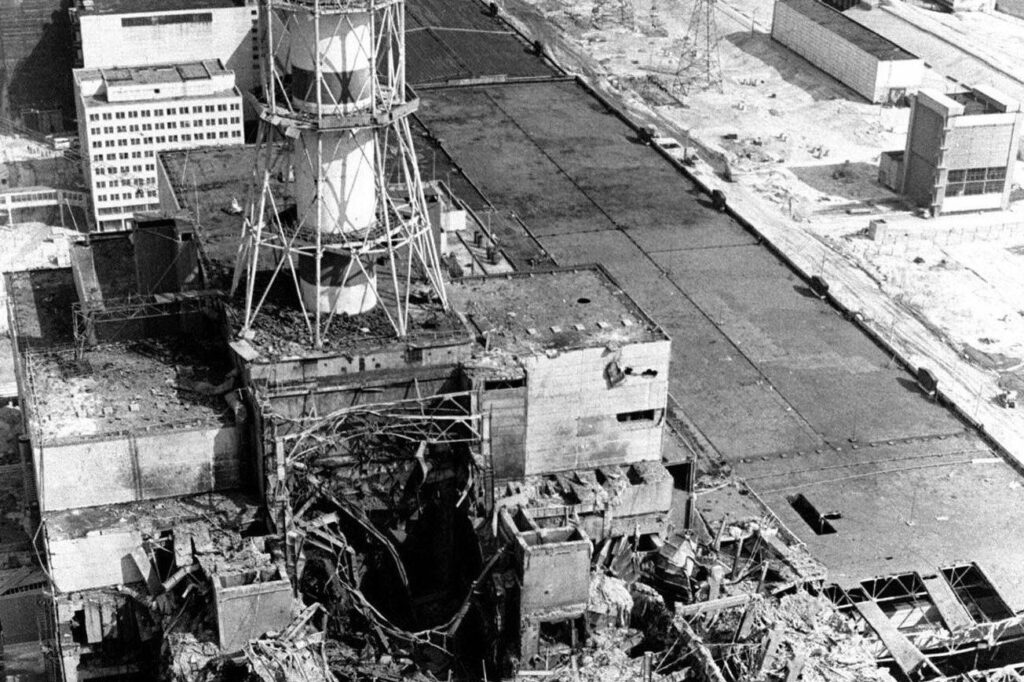
Why measuring radiation from the air is hard
Radioactive materials give off gamma rays, a very energetic kind of light that our eyes can’t see. Each material sends out gamma rays at its own set of energies, a bit like a barcode. A detector that reads those energies can, in principle, tell you exactly what is down there.
From a helicopter, though, that barcode gets smudged. On the way up, the gamma rays bounce off the air and off the aircraft itself, losing energy and blurring the clean pattern into a messy smear, explains the University of Michigan’s announcement. With only a few seconds of data from a moving aircraft, the signal is also weak. That makes it hard to say precisely what is down there, how much of it and exactly where.
How the new method reads the smudged barcode
The team, led by David Breitenmoser, combined two ideas. First, detailed computer simulations of how gamma rays travel through air and through the helicopter, which produce thousands of “what the detector should see” templates for different materials, amounts and positions. Second, Bayesian inference, a statistical way of weighing evidence, much like a detective who keeps updating the list of suspects as each clue comes in. The method compares the real, blurred measurement with the templates and works out which explanation fits best, and how sure it can be.
The clever part is speed. The researchers split the physics into two pieces: the scattering in the air, which depends on temperature and humidity, and the scattering inside the aircraft, which can be calculated in advance for that helicopter model. “Simulations that had taken hours or days could be evaluated in microseconds,” Breitenmoser says in the university’s release, adding that the gain came from reorganising the physics rather than buying more computing power.
The test: one pass, six seconds
The flights took place on 16 June 2022 at the Thun military training ground in Switzerland, during an exercise run with the Swiss airborne radiation-mapping system, according to the paper. That system carries a large crystal detector, about 17 litres of sodium iodide, in the cargo bay of a Super Puma helicopter. On the ground, the team placed sealed test sources of caesium-137 and barium-133, first one at a time and then both together.
The helicopter flew straight over them once, about 30 metres up and at roughly 10 metres per second (36 km/h). From just six seconds of that single pass, the method:
- told the two materials apart, even when they sat side by side, with very high statistical confidence;
- placed the sources to within about 2 metres;
- estimated how strong they were to within about two percentage points of the true values, as checked against independent measurements on the ground and in the lab.
What it can and can’t do yet
This is a careful first demonstration, not a finished product. The flight data come from one test campaign, with one helicopter type and known test sources in open terrain. The aircraft part of the model was prepared for that specific helicopter, so other aircraft would need their own version. Real emergencies are messier: many sources, buildings, hills and changing weather.
Still, the authors see wide uses: emergency response, routine monitoring around nuclear facilities, environmental clean-up, geology and mineral surveys, and even reading gamma rays from the surfaces of the Moon or Mars, where orbiters already carry gamma-ray detectors.
What happens next
The next step is to try the method on more aircraft, more complex scenes and larger areas, so that emergency teams could one day get a clear, trustworthy map from the very first flight. For anyone living near a nuclear plant, that means faster and clearer advice when every hour counts.
Read next
- First nuclear clocks: thorium atoms now keep time by themselves
- AI weather forecasts get sharper up to a month ahead
- Bennu samples reveal a hybrid asteroid born near the ice line
The week's best tech stories, free
One email a week with the stories that matter, explained simply. No spam.
Sources
- Quantitative mobile gamma-ray spectrometry through Bayesian inference – Nature Communications (Breitenmoser, Stabilini, Kasprzak, Mayer; University of Michigan and Paul Scherrer Institute), 26 October 2026
- Faster, more accurate airborne radiation detection demonstrated in six-second helicopter flyovers – Tech Xplore (University of Michigan, Patricia DeLacey), 26 October 2026
- Decoding radiation – Paul Scherrer Institute (background on the Swiss airborne gamma-ray system)