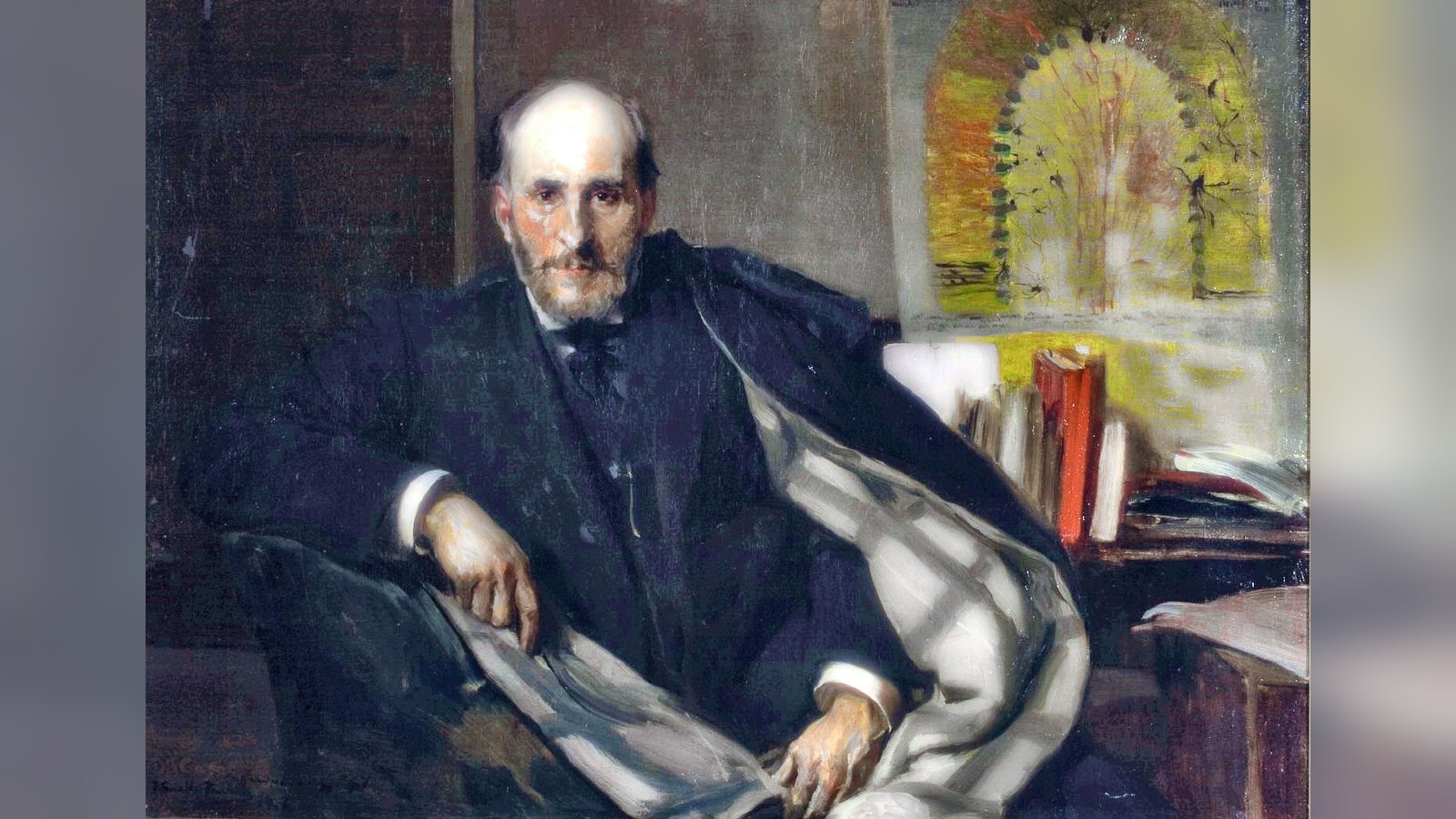
The next episode of our documentary series SPANISH GENIUSES is about the man who showed how the brain is built. Looking through a microscope and drawing what he saw, Santiago Ramón y Cajal proved that the brain is made of separate cells, and won the Nobel Prize for it. Chapter 5, “Ramón y Cajal: the man who drew the brain”, is coming soon.
A boy who wanted to paint
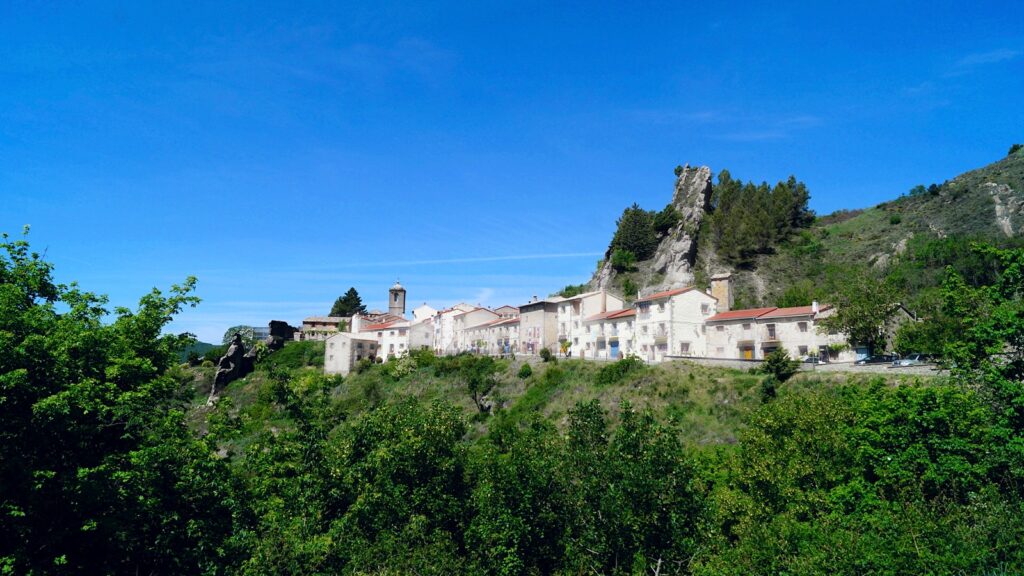
Cajal was born on 1 May 1852 in Petilla de Aragón, a small village of Navarre surrounded by the province of Zaragoza, according to the Nobel Prize website. As a boy he wanted to be a painter. His father, a doctor, would not allow it and sent him to work for a barber and then for a shoemaker, as his Nobel biography tells. He was a restless child: in his memoirs, Recuerdos de mi vida, he tells how, at eleven, he built a cannon from a wooden beam, blew a hole in a neighbour’s new gate and spent three days in the village jail.
In the end he studied medicine in Zaragoza and graduated in 1873, aged 21. As an army doctor he was sent to Cuba, where he caught malaria and came home very ill in 1875.
A black stain and a big question
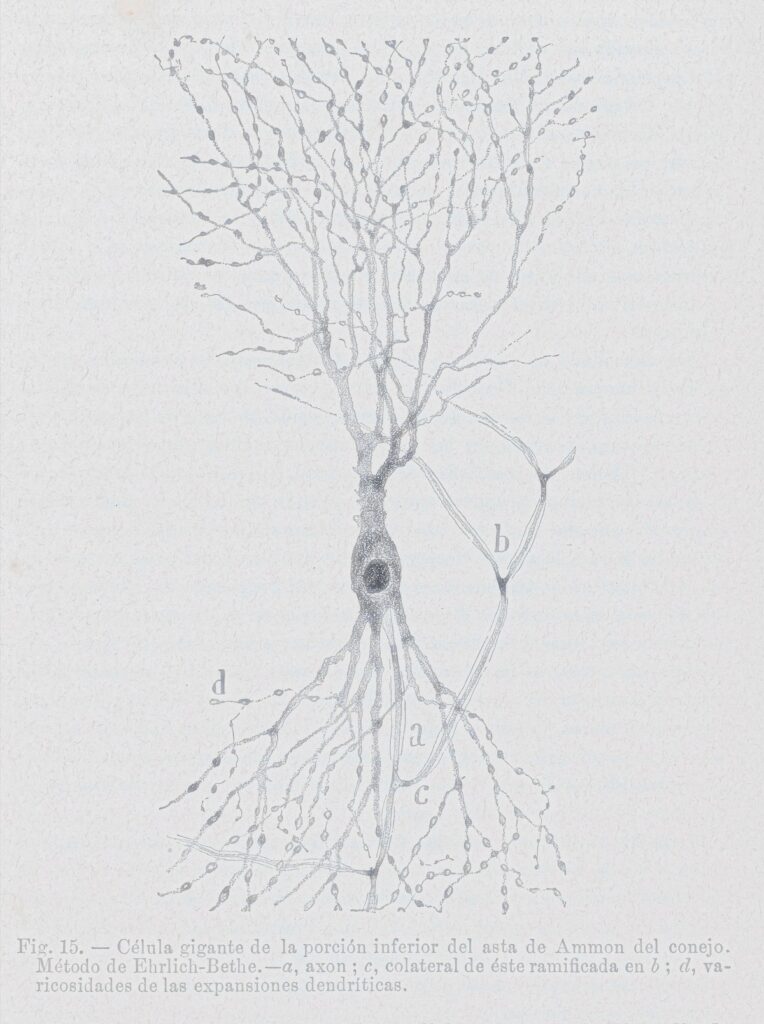
In 1873 the Italian scientist Camillo Golgi found a way to stain nerve cells black with silver. Only a few cells take the colour, but each one shows up whole. In 1887 Cajal saw these preparations for the first time, at a colleague’s house in Madrid, and made the method his own: he improved it and used it on embryos and young animals, where the cells are simpler to see, explains Javier DeFelipe of the Instituto Cajal in Anatomical Science International.
At the time, many scientists, Golgi among them, believed the nervous system was one continuous net of fused fibres. From 1888 Cajal showed something different: each nerve cell is a separate unit, and nerve cells touch each other without merging. That idea is the basis of how we understand the brain today.
A shared Nobel Prize
In 1906 Cajal and Golgi shared the Nobel Prize in Physiology or Medicine “in recognition of their work on the structure of the nervous system”. In Stockholm they still disagreed: Golgi began his Nobel lecture by saying he had always been opposed to the neuron theory, and the next day Cajal defended it in his own.
The man who drew the brain
Cajal drew what he saw under the microscope with ink and pencil, and nearly 2,000 of his scientific drawings survive in the Legado Cajal, the collection kept by Spain’s research council (CSIC). In 2024 Spain declared that collection a protected cultural asset. He was also a keen photographer who made 3D (stereoscopic) pictures and early colour photographs, and he wrote a famous book of advice for young scientists, Reglas y consejos sobre investigación científica (1897), known in English as Advice for a Young Investigator.
He died in Madrid on 17 October 1934. Today he is often called the father of modern neuroscience. His archives have been part of UNESCO’s Memory of the World Register since 2017, and his drawings toured North America in the exhibition “The Beautiful Brain” from 2017 to 2019.
How to watch the series
Chapter 5 arrives soon on our YouTube channel and on the series page, told with real archive images and every fact checked against reliable sources. Until then you can watch Chapter 1, Leonardo Torres Quevedo, Chapter 2, Emilio Herrera, Chapter 3, Juan de la Cierva, and Chapter 4, Isabel Zendal, or see every episode on the SPANISH GENIUSES page. Subscribe to TechNews on YouTube and turn on notifications so you don’t miss it.
Read next
- New series Spanish Geniuses: Isabel Zendal and the first international vaccine
- New series Spanish Geniuses: Autogiro: the “parachute” plane
- New series Spanish Geniuses: Emilio Herrera, pioneer of the astronaut’s suit
The week's best tech stories, free
One email a week with the stories that matter, explained simply. No spam.
Sources
- Santiago Ramón y Cajal – Facts – NobelPrize.org
- Santiago Ramón y Cajal – Biographical – NobelPrize.org (from Les Prix Nobel, 1906)
- The Nobel Prize in Physiology or Medicine 1906 – NobelPrize.org
- The neuron doctrine – theory and facts – Camillo Golgi, Nobel Lecture, 11 December 1906
- The structure and connexions of neurons – Santiago Ramón y Cajal, Nobel Lecture, 12 December 1906
- Recuerdos de mi vida, vol. I: Mi infancia y juventud – Santiago Ramón y Cajal, 1917, Project Gutenberg (in Spanish)
- Cajal and the discovery of the Golgi method: a neuroanatomist’s dream – Javier DeFelipe, Anatomical Science International, 2025
- The Histological Slides and Drawings of Cajal – Pablo García-López, Virginia García-Marín and Miguel Freire, Frontiers in Neuroanatomy, 2010
- Art, Intuition, and Identity in Ramón y Cajal – Dawn Hunter, Javier DeFelipe, Arpan R. Mehta and Bevil R. Conway, The Neuroscientist, 2024
- Real Decreto 361/2024, Legado Cajal declared Bien de Interés Cultural – Boletín Oficial del Estado, 3 April 2024 (in Spanish)
- Archives of Santiago Ramón y Cajal and the Spanish Neurohistological School – UNESCO Memory of the World
- The Beautiful Brain: The Drawings of Santiago Ramón y Cajal – Weisman Art Museum, University of Minnesota