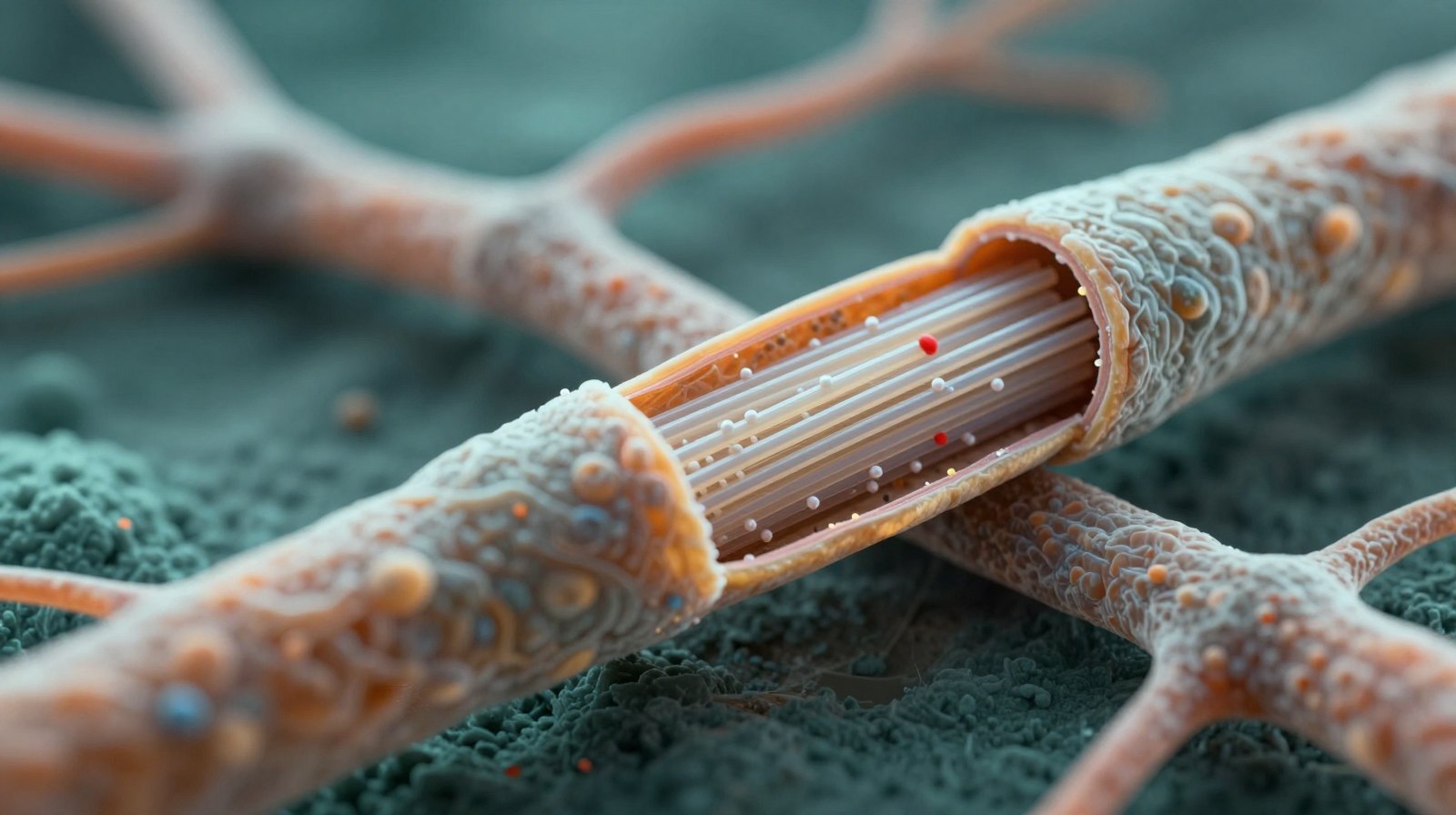
Every day, in hospitals all over the world, a gas switches people’s minds off and, an hour later, switches them back on. Anaesthesia works beautifully, yet nobody can say exactly how it makes consciousness disappear. That gap is one reason a bold, decades-old idea from Nobel laureate Roger Penrose keeps coming back: that our conscious moments might begin inside tiny tubes in our brain cells, through quantum physics. Recent experiments with anaesthetics have given the idea new attention, and new arguments.
Why it matters: consciousness is the biggest open question in science. If even part of it depends on quantum effects inside cells, it would change how we think about the brain, about anaesthesia and coma, and about whether a computer could ever truly be aware (a question we explored in Can AI be conscious?). If it doesn’t, finding out why is still a big step forward.
The idea: consciousness in tiny tubes
Roger Penrose is a mathematical physicist who shared the 2020 Nobel Prize in Physics for showing that black holes are a robust prediction of Einstein’s theory of gravity. Back in the late 1980s and 1990s, in his books The Emperor’s New Mind and Shadows of the Mind, he argued that human understanding can’t be fully captured by step-by-step computation. Something non-computable, he suggested, must be going on in the brain, and he looked to quantum physics to find it.
He teamed up with Stuart Hameroff, an anaesthesiologist at the University of Arizona, and together they proposed a theory called Orchestrated Objective Reduction, or Orch OR. Here’s the short version:
- Inside every neuron there’s a scaffolding of microtubules: hollow tubes about 25 nanometres wide (thousands of times thinner than a hair) built from a protein called tubulin. They give the cell its shape and act as rails for transport.
- Orch OR proposes that tubulin units can hold quantum states, being in several states at once (superposition), linked across many microtubules.
- Penrose’s own physics idea says such superpositions can’t last forever: once enough mass is spread across different states, gravity forces them to “choose” one. He calls this objective reduction.
- Each of these orchestrated choices, the theory says, is a moment of conscious experience.
It’s a beautiful, sweeping theory. It’s also deeply controversial, and most neuroscientists prefer explanations based on ordinary, classical brain signals.
The anaesthesia clue
This is where anaesthesia comes in. If microtubules really matter for consciousness, then drugs that switch consciousness off might be acting on them, and changing the microtubules should change how well those drugs work.
A rule that sounds backwards
Anaesthesia also has a famous twist that seems to turn common sense upside down: the strongest anaesthetic gases are the ones you need the least of. More than a century ago, the pharmacologists Hans Meyer and Charles Overton noticed that a gas’s power tracks how easily it dissolves in oil. The more “oil-loving” a gas is, the lower the concentration needed to put an animal to sleep, a pattern known as the Meyer-Overton correlation. (For any single gas, of course, a higher dose still means deeper anaesthesia; the surprise is in comparing different gases.) The clue suggests anaesthetics do their work in oily, water-repelling pockets, which scientists today place mainly inside proteins. Supporters of the microtubule idea point out that tubulin has pockets like these: a 2017 computer study in Scientific Reports, co-authored by Hameroff, predicted that anaesthetics shift tubulin’s collective vibrations in step with how potent they are in the clinic, while two similar non-anaesthetic molecules did not. The rule also has exceptions (some very oil-soluble molecules don’t anaesthetise at all), so it is a clue, not a proof.
In 2024, a team led by neuroscientist Michael Wiest at Wellesley College in the US put that to a test, publishing the results in eNeuro. They gave rats a drug called epothilone B, which binds to microtubules and stabilises them, then exposed the animals to the anaesthetic gas isoflurane. They measured how long each rat took to lose its “righting reflex” (the instinct to roll back onto its feet), a standard sign of unconsciousness in animal studies.
- Rats given the microtubule drug took on average about 69 seconds longer to go under.
- Seven of the eight rats in the main group showed the delay, and the statistical effect was large.
- The researchers checked that simply getting used to the gas (tolerance) couldn’t explain the whole delay.
The authors conclude that isoflurane acting on microtubules helps cause unconsciousness. In Wellesley’s announcement, Wiest argued that since no known classical mechanism explains why anaesthetic binding to microtubules would broadly reduce brain activity, the result favours a quantum view of consciousness. In 2025 he went further, gathering this and other lab results into a review in Neuroscience of Consciousness that argues a quantum microtubule basis for consciousness is experimentally supported.
Reasons to stay cautious
Exciting? Yes. Settled? Not at all. Here’s what keeps many scientists sceptical:
- A small first study. Eight rats, one dose, and sessions that were not randomised (the drug session always came after the control session). The authors list these limits themselves. The finding needs independent repeats.
- Microtubules, yes; quantum, not proven. Even the paper notes its result is also potentially consistent with classical explanations. Showing that anaesthetics affect microtubules is not the same as showing consciousness is quantum.
- The warm, wet brain problem. Quantum states are fragile. In 2000, physicist Max Tegmark calculated in Physical Review E that quantum coherence in the brain would fall apart in roughly 10-13 to 10-20 seconds, far faster than the thousandths of a second that neurons work on. Orch OR supporters have disputed the assumptions behind that estimate, and the debate continues.
- The gravity part took a hit. Penrose’s idea that gravity collapses superpositions was tested deep under a mountain at Italy’s Gran Sasso laboratory. The study, published in Nature Physics in 2020 and reported by Physics World, looked for the faint radiation the simplest version of the model predicts, didn’t find it, and ruled out that simplest version. The researchers stressed that gravity-related collapse in general is not excluded.

Key takeaways
- Orch OR says moments of consciousness arise from quantum processes in microtubules, ended by gravity. It remains a minority, contested theory.
- A 2024 rat study found that stabilising microtubules delayed anaesthesia by about a minute, a real clue that microtubules matter for how anaesthetics work.
- Whether that clue points to quantum consciousness is still open; decoherence and the Gran Sasso test are serious challenges.
What happens next
The good news is that a once purely philosophical idea is now producing experiments that can fail. Wellesley’s team is trying similar tests in mice and even single-celled organisms, according to the college’s magazine. Independent labs repeating the rat result, larger and randomised studies, and direct measurements of quantum effects in living neurons would move the debate from “fascinating” to “known”. Whichever way it goes, the question of how a gas can turn off a mind is about to get a lot more interesting.
Sources
- Microtubule-Stabilizer Epothilone B Delays Anesthetic-Induced Unconsciousness in Rats – S. Khan, …, M. C. Wiest (Wellesley College), eNeuro, August 2024
- Wellesley team’s new research on anesthesia unlocks important clues about the nature of consciousness – Wellesley College, 3 September 2024
- A quantum microtubule substrate of consciousness is experimentally supported and solves the binding and epiphenomenalism problems – M. C. Wiest, Neuroscience of Consciousness, 2025
- The importance of quantum decoherence in brain processes – M. Tegmark, Physical Review E 61, 4194 (2000)
- Meyer-Overton correlation – OpenAnesthesia (International Anesthesia Research Society)
- Anesthetic Alterations of Collective Terahertz Oscillations in Tubulin Correlate with Clinical Potency – T. J. A. Craddock, …, S. R. Hameroff, J. A. Tuszynski, Scientific Reports, 2017
- Physicists place fresh limits on gravity’s role in wavefunction collapse – Physics World, September 2020 (on Donadi et al., Nature Physics, 2020)
- The Nobel Prize in Physics 2020 – NobelPrize.org
- Joining the quantum conversation – Wellesley Magazine, Summer 2025