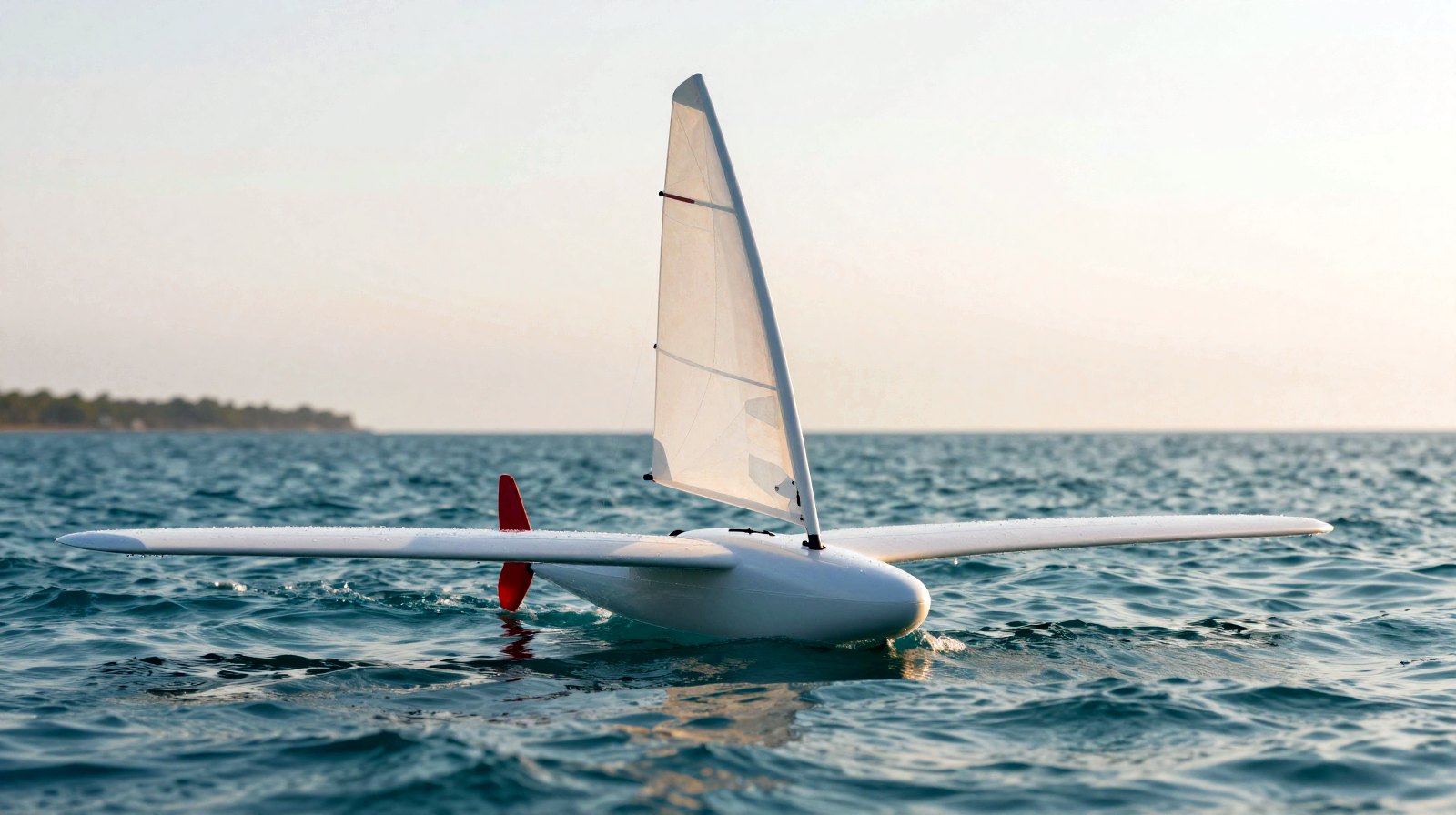
When an oil spill, an algal bloom or a storm hits a remote stretch of sea, scientists need measurements fast. Ships take days to get there; instruments dropped from planes usually work once and sink. A team in Singapore has built a little robot that does both jobs: it falls from the sky spinning like a maple seed, lands softly on the water, flips itself upright and then sails off on its own, powered by the wind. It’s called ALBATROSS, and it is described in a new paper in the journal Science Robotics.
One body, three jobs
ALBATROSS stands for “Airborne Lander with Buoyant AuToROtating Sailing Sensor”. It was built by researchers at the Singapore University of Technology and Design (SUTD), with a team that includes Shaohui Foong, and weighs just 1.1 kg, according to The Register and Yacht.
The clever part is that the same few parts do everything:
- Falling: released from a plane or a drone, its two rigid wing-sails make the whole body autorotate, spinning like a sycamore or maple seed. The spin slows the fall and softens the splash, so it needs no parachute and no landing gear.
- Landing: its weight sits low in a keel, so if it lands upside down it rights itself in under a second, Yacht reports.
- Sailing: on the water, the same wings become sails. A rudder that sweeps side to side like a fish’s tail steers the boat and adds a little push when the wind drops.
All of this runs on just three small motors and a handful of navigation sensors, including GPS and a compass, which is why it can be so light and simple.

What the tests showed
In trials near Singapore, a small prototype was dropped from a drone at about 150 metres; the spinning steadied its descent. A larger test version then sailed autonomously between set waypoints for about three hours while recording environmental data, Yacht reports. The team says the design could cover more than 100 km on wind power, according to The Register, which notes that this figure is the makers’ claim rather than a measured result.
Why it matters: today’s ocean tools force a trade-off. Buoys and robotic sailboats can stay out for a long time but must be launched from a ship or the shore and can take days to arrive, while air-dropped probes arrive quickly but are usually single-use. ALBATROSS aims to arrive fast and keep working, and its makers say it could even sail back to shore at the end of a mission so it can be reused.
A dose of realism
It’s an early research prototype. All the tests so far took place in sheltered waters near Singapore, not on the open ocean. Yacht points out that the small craft isn’t built yet for big waves, strong currents or long missions, and that questions such as collision avoidance, navigation lights and the legal status of tiny autonomous boats remain open. It’s meant for short, time-critical observations, not to replace long-lived drifting buoys.
What could it be used for?
- Disasters: dropping several sailing sensors over an oil spill or after a storm to map conditions within hours.
- Science: checking an algal bloom or water quality in a specific area without sending a ship first.
- Low cost and low energy: wind does the travelling, so the battery only runs the electronics and the three small motors.
It’s a neat example of a trend in robotics: instead of adding more motors and parts, let the shape of the machine do the work. Nature figured that out with the maple seed long ago.
Read next
- AI drone with one camera beats world champion pilots
- Frog-like robot hops and swims with snapping spring legs
- Nobel Prize in Physics 2026: a telescope made of Antarctic ice
Sources
- Research paper on ALBATROSS (DOI 10.1126/scirobotics.aed1423) – Science Robotics, Shane Kyi Hla Win, Shaohui Foong et al. (SUTD), 2026
- It’s a bird, it’s a plane… well, more of a spinning parachute, but really it’s a droppable robot boat – The Register, 8 October 2026
- Sail probes: Will ‘ghost ships’ soon be falling from the sky? – Yacht, 5 October 2026